

 RETURN
18.01.2021
TYPES OF VR DEVICES | What are the types of Virtual Reality glasses that exist?

HIPEREXPERIENCIA
LOADED


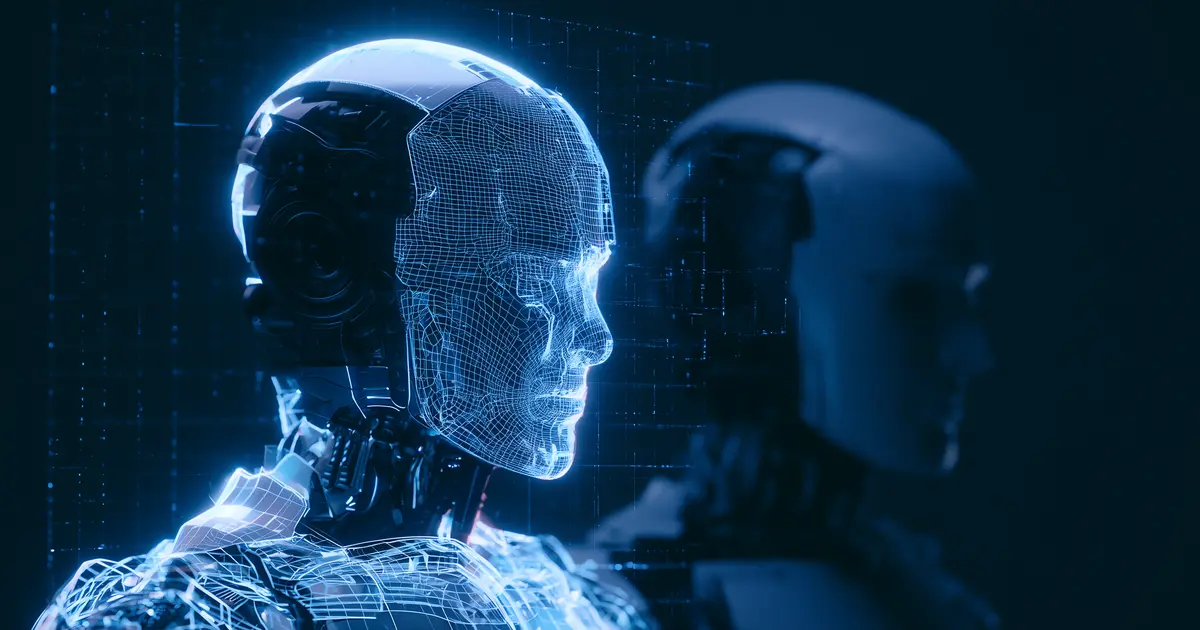
In just over two years, humanoid robotics has gone from a lab demo to a market that multiple analyses place on a path of sustained growth over the next decade, with estimates pointing to a jump from today's $5.41 billion to more than $50 billion by 2035 (Xataka, 2026). But before any bipedal robot takes its first step in a factory, a hospital, or a corporate event, it has spent months learning to move inside a world that doesn't exist: a digital replica built with the same physical precision as a flight simulator.
This article looks at how that virtual training works and why it has become the mandatory step before deploying a humanoid robot in the real world. The analysis combines more than 12 years of DeuSens' experience designing digital twins, simulation environments and virtual reality with peer-reviewed studies and industry-leading sources — from NVIDIA to reviews published in Annual Reviews —, cited one by one throughout the text and gathered in the sources section at the end.
A digital twin is a virtual representation of a physical object, environment or system, built with enough fidelity — geometry, physics, materials, lighting — for its simulated behaviour to be representative of the real one. In robotics, this idea translates into platforms like NVIDIA Isaac Sim, which let teams build, train and validate AI-powered robots inside environments that replicate factories, warehouses or workspaces before the physical robot even exists or is deployed (NVIDIA). At DeuSens we've spent years building 3D digital twins for very different sectors — industry, heritage, training — and the underlying technical principle is the same one that supports humanoid robot training today: the more faithful the virtual replica, the more useful what's learned inside it becomes. You can see how we apply this to industrial environments in our article on 3D digital twins for industry.

Beyond static replicas, labs like DeepMind have started exploring so-called "world models": generative systems capable of creating playable, action-controllable 3D environments specifically to train and evaluate physical agents, robots included. NVIDIA follows a parallel logic with its Cosmos platform, aimed at accelerating physical AI development through generative world models. Both approaches point in the same direction: generating the range of situations a robot needs to see before facing the far less controllable variety of the real world.
The technical process has a name in the scientific literature: sim-to-real transfer. A systematic review published on arXiv describes it as training control policies through reinforcement learning inside a simulated environment, before deploying them on the physical robot, thereby avoiding the cost and risk of training directly on real hardware (Zhao et al., 2020). The robot rehearses inside the virtual environment — walking, balancing, manipulating objects, recovering from a stumble — thousands or millions of times, something that would be unfeasible, slow and dangerous to replicate on a physical unit.
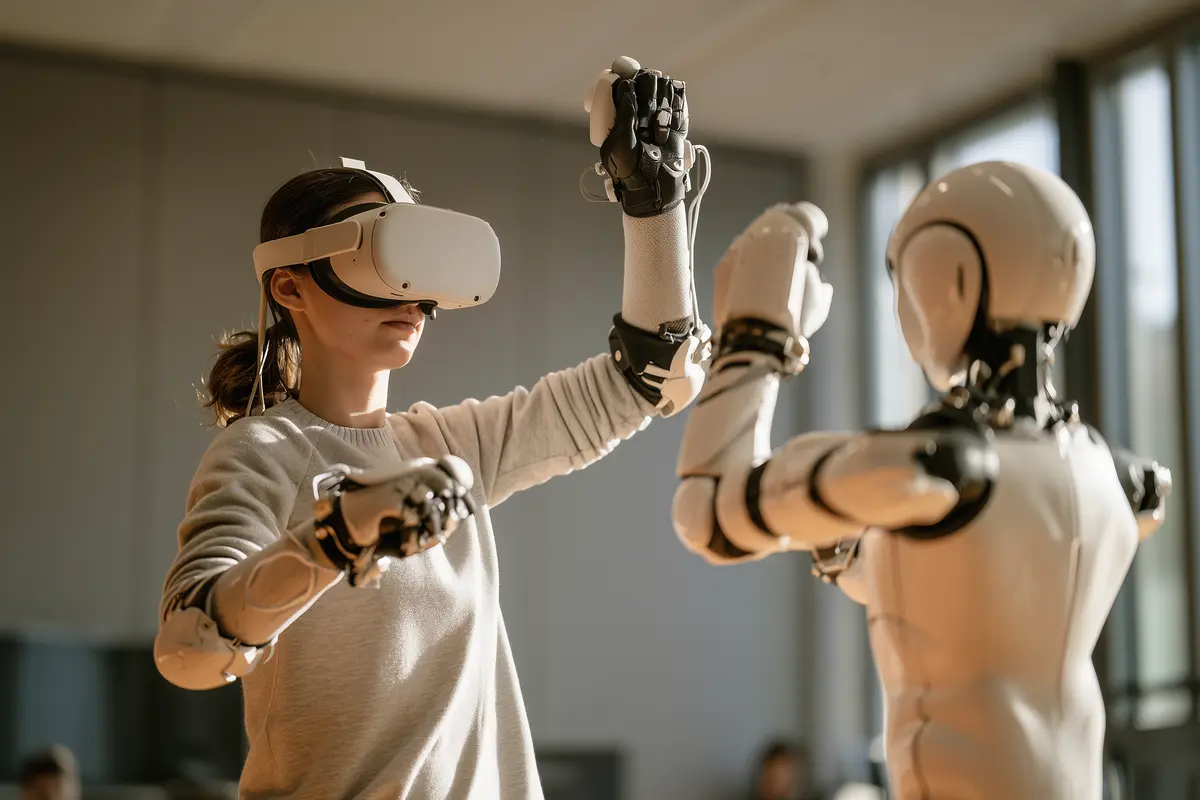
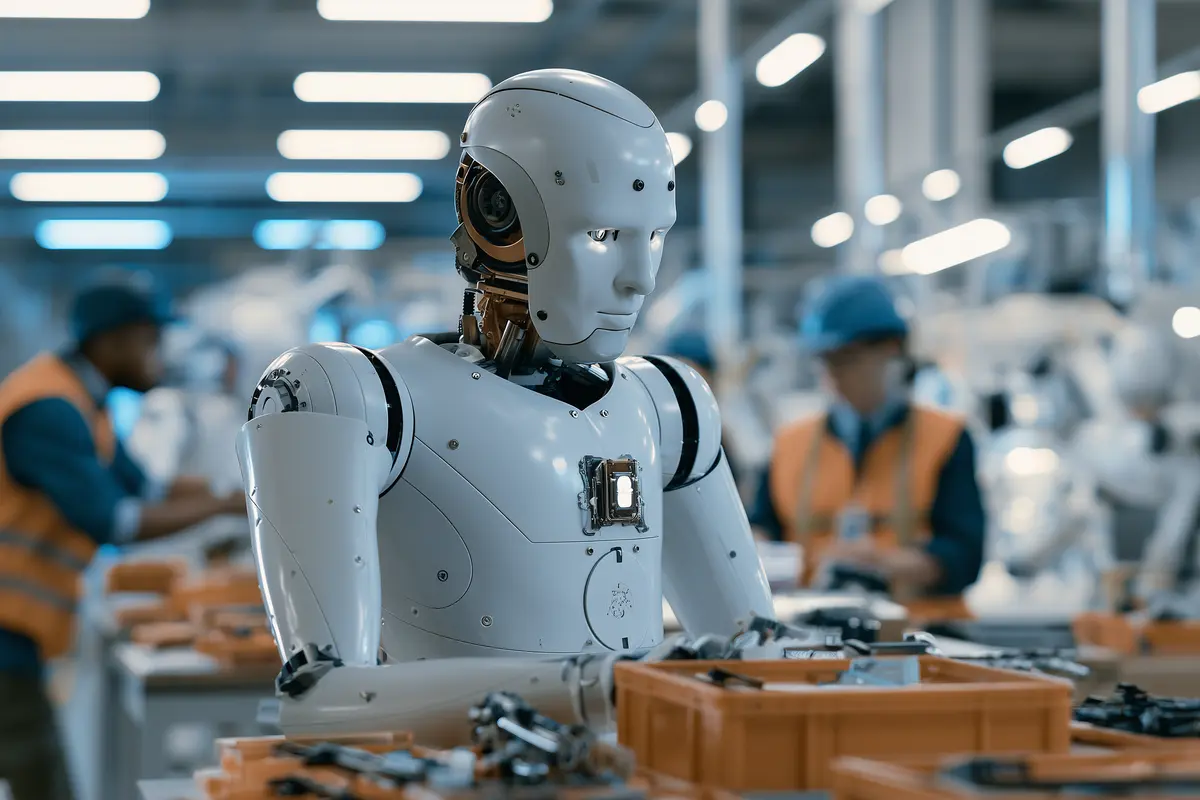
A case documented by NVIDIA together with Agility Robotics illustrates the scale of the process well: their Digit humanoid robot was trained across billions of simulation steps before operating in real warehouses for clients such as GXO Logistics and Schaeffler, cutting development cycles from weeks to days compared with training directly on hardware (NVIDIA). The principle — rehearsing first in a safe, controlled environment before moving to the real scenario — isn't exclusive to robotics: it's the same one we apply at DeuSens when we design immersive VR training with haptic gloves for AENA, where the goal was likewise for people to practise critical procedures in a virtual environment before carrying them out in the real world.
The reason the industry has adopted this approach almost universally is both economic and safety-driven. A Google Research study on sim-to-real transfer notes that collecting real-world data for robot learning is slow and costly, while simulated environments offer a virtually unlimited data source and remove much of the physical risk associated with training directly on hardware (Google Research).
The case of Humandroid, a Córdoba-based startup specialising in deploying industrial humanoid robots, illustrates the applied side of this technology well: their methodology combines digital twins that replicate the client's plant with synthetic data generation, so the robot practises thousands of times in a safe environment before touching the real production line (Infonegocios). In Spain, the Automotive Technology Centre has since 2026 driven the HAARO lab, specifically focused on training, simulating and validating humanoid systems through digital twins and reinforcement learning before their deployment in real industrial environments (Galicia Press).
It's worth being precise, though: the scientific literature itself acknowledges that this transfer is not perfect. A review published in Annual Reviews in Control, Robotics, and Autonomous Systems describes the so-called "reality gap" — the inevitable discrepancies between simulated and physical behaviour — as one of the field's most persistent open challenges, and devotes much of its analysis to the methods the industry uses to reduce it, not eliminate it (Annual Reviews, 2024). It is, in other words, a mature but still actively developing technology, not an infallible formula.
Real-world adoption, however, still trails media interest by some distance. According to recent industry data, 78% of Spanish companies have already integrated some form of robotics into their processes, but only 5% of that robotics corresponds to humanoid platforms, versus a clear preference for simpler cobots and mobile robots (El Ecosistema Startup). China, for its part, has taken the concept of virtual training a step further with so-called "VR schools" — centres where human operators train humanoid robots through teleoperation and virtual reality before the robot itself moves on to more autonomous operation (El Ecosistema Startup).
In 2026, the Associated Press documented how one of these training schools operates in Shijingshan, near Beijing, where engineers wearing VR headsets control dozens of humanoid robots as they learn everyday tasks such as folding clothes or handling industrial parts:
Source: Associated Press / El Mundo.
What connects all these cases — from Isaac Sim to China's VR schools, via Humandroid and HAARO — is a shared infrastructure: high-fidelity digital twins, physics-based simulation environments and virtual reality tools. It's exactly the territory where robotics, AI and XR converge, a convergence we look at in more detail in this article on robotics, AI and XR, and one we saw up close at the latest edition of MACHINA Summit 2026. At DeuSens we don't build robots, but we do build the same kind of digital twins and immersive simulation environments that make this type of training possible — applied, in our case, to training, industrial visualisation and brand experience.
Physical AI is the term the industry uses for artificial intelligence models capable of understanding and interacting with the physical world, as opposed to models that only process text or images. Humanoid robots, autonomous vehicles and industrial manipulators are the most advanced applications of this category (NVIDIA).
It depends on which phase you measure. Training the base model in simulation is measured in simulation steps, not calendar time: the Agility Robotics case documented by NVIDIA involved billions of such steps before real-world deployment. Adapting an already-trained robot to a specific plant is a separate, much shorter phase: Humandroid, for instance, aims for a robot to learn new tasks in an already-familiar environment in as little as 24 hours of observation.
A digital twin is the persistent virtual replica of a space, object or robot, built with physical and geometric fidelity. Robot simulation is the process that runs inside that digital twin: the set of trials, iterations and scenarios through which a robot learns a task. A single digital twin can host thousands of different simulations.
It's the performance difference observed when a robot trained in simulation is deployed in the real world, caused by the inevitable physical and visual approximations of any simulated environment. Reducing this gap — not eliminating it entirely — is one of the most active research focuses in robotics, according to the review published in Annual Reviews (2024).
Not yet, at least not universally. Most processes combine reinforcement learning in simulation, synthetic data generation and, in many documented cases, human supervision or teleoperation in the early stages — as in China's so-called "VR schools" — before the robot operates with greater autonomy in the real environment.
A humanoid robot is a physical system that needs this simulation-based training precisely because it has to move and interact with the material world. A conversational AI avatar, by contrast, has no physical body or balance/locomotion constraints: its "training" is purely linguistic and conversational. We explore this second category in more depth in our article on AI agents and virtual avatars.
SIMILAR CONTENT

PRIVACY POLICY
By chatting you accept our Privacy Policy.
By chatting you accept our Privacy Policy.
Conversation sent. We will be in touch shortly. New conversation


