

 RETURN

18.01.2021
TYPES OF VR DEVICES | What are the types of Virtual Reality glasses that exist?

HIPEREXPERIENCIA
LOADED


✅ Coverage complete — Last updated: 9:08 PM in Europe (12:08 PM in California).
Summary: the morning wrapped up with the Growth block and its full figures ($1.7B in creator earnings, India and Japan surging, more than half of global gaming industry growth in 2025 per Matthew Ball) and the underlying vision for the future of creation, ahead of the Q&A with Builderman and a lunch break. Revisit our full minute-by-minute coverage of the morning below.
The Roblox Developers Conference (RDC) is Roblox's flagship invite-only event, bringing together the platform's most relevant creators, brands, and studios worldwide. The 2026 edition runs from September 10 to 12 in San Jose, California, closing with the Roblox Innovation Awards on the final day.
We lived this experience last year at RDC 2025, attending as the only Spanish studio invited alongside our partner BrandNewVerse. In 2026 we're back, with DeuSens's two co-founders, Álvaro Monzón and Álvaro Antoñanzas, once again in San Jose. Our alliance with BrandNewVerse — Spain's leading Roblox development studio, of which DeuSens has been the second-largest shareholder since 2025 — remains our gateway into the ecosystem.
Roblox streams the keynotes of the Roblox Developers Conference 2026 (RDC26) openly through its official YouTube channel. You can follow the full stream here:
To close, it was emphasized that all of this growth is credited entirely to the creator community, not to the platform itself. Up next is a Q&A session with Builderman (David Baszucki), kicking off with a predictions segment, followed by a lunch break before the day resumes.

As a conceptual close to the whole Growth block, Roblox argued the industry is on the verge of a full transformation driven by new creative tools, drawing on a historical precedent: new tools have always expanded the pool of creators, never shrunk it. The stated goal is for building interactive worlds to become as common as making a video or writing a story. Play was framed as a deeply human, connective activity, essential not just to Roblox but to the entire entertainment industry — gaming, toys, sports.
Roblox now accounts for roughly 20% of under-18 gaming revenue in the US. The 18-34 audience is up 42% year over year, with hours played up 37%. International growth is also accelerating: daily active users in India were up 64% last quarter, and in Japan, up 67%. Per analyst Matthew Ball, quoted on screen, Roblox accounted for more than half of the entire global gaming industry's growth in 2025.
As a closing figure for the platform's growth: total creator earnings have reached $1.7 billion over the last 12 months. We already knew the top 10 creators had grown their earnings 3.6x since 2020, but the figure Roblox chose to highlight was different: the creator ranked 1,000th grew even faster, at 4.3x — the long tail is growing fastest of all the tiers. Specifically, creators ranked between 1,000 and 10,000 average more than $30,000 a year.

As market context, a key figure: Roblox already accounts for roughly 20% of under-18 gaming spend in the US, based on external TAM estimates combined with internal company data — the baseline behind the platform's growing, still largely untapped focus on adult audiences.

And on the growth in creator earnings over recent years: the top 10 creators average $65.7 million a year (3.6x since 2020); the top 100, $10.8 million a year (4x since 2020); and the top 1,000, $1.4 million a year (4.3x since 2020). Per the slide's own footnote, this data covers the last 12 months as of June 30, 2026, and while Roblox's creator ecosystem includes many hobbyists, more than 42,000 creators are part of the DevEx program, with a median creator earning approximately $1,500 over those same twelve months.

The keynote paused for a memorial tribute to the company's four original co-founders. David Baszucki (Dave) led the tribute, joined on stage by John (one of the original co-founders) and by Rebecca, wife of the late co-founder Eric Castle. Matt Ducek, another of the original founders, was also referenced; he was unable to attend in person.
Dave honored Eric Castle as a foundational contributor whose work shaped core systems of the platform, leading the integration with Luau and the multiplayer replication system — described as an essential part of what Dave called an "optimal group of four." Rebecca, for her part, thanked Dave for keeping Eric's legacy alive through the ongoing work at Roblox.
The roles of the original four founders, as recapped on stage: Dave — the engine; Eric — Luau and Studio; Matt — the social graph; and John — live-ops innovation.
John shared a memory from Roblox's early years: extremely rapid iteration, by the hour, with new builds daily. The key insight from that era, in his own words: the most exciting thing about Roblox was that it was free. Dave, for his part, described the founding team as a "D&D four-person crew," with each of them spiking in a different area.


A second speaker briefly joined the stage to reinforce this block before continuing solo.

As a visual summary of this whole philosophy of opening up toward the browser, standalone app, and shareable links, the screen showed three words: "Share," "Open," and "Play."


The block itself carried an official title on screen: "Games in your Browser."


A diagram broke down the comparison between "Roblox App" (all Roblox games) and "Roblox Everywhere" (a single game, like TTK), across seven axes — look and feel, play, distribution, executable size, cloud services, creation, and social: distribution is similar (direct on PC or through storefronts), and underneath, both share exactly the same Roblox Cloud (engine, persistence, economy, social, safety), the same Roblox Studio (Build, Studio Build, Map), and the same Roblox Social (CoPlay, chat, friends and community).

The demo showed it live: a Windows desktop with just two icons, "TTK" and "Roblox," visually confirming that the standalone app lives as its own executable right next to the regular client.

Inside that standalone app, a tactical first-person shooter was shown running in night vision, with a PDW-5 weapon and the full control scheme listed on screen (aim, NVG, flashlight, sprint, crouch, fire mode...).

And to prove browser playability, three different games were opened live from play.roblox.com links, with no Roblox client installed: "Pirate Vineyard Run," with an avatar waiting for the next round to start ("Preparing the next voyage");

"Jungle Blaster," by creator MrChickenRocket, loading a server;

and "Hypershot," a capture-the-flag shooter running live inside the browser, complete with scoreboard and player list on screen.

More screenshots from the same game round out the demo: the loading screen with the "Hypershot" logo, the notice that cheating means a permanent ban with no second chances and that there are two free abilities every week; the game's info card, credited to studio Frosted Studio; and a generic loading screen branded "Roblox Web Play," confirming this is the actual browser-play technology showcased in this block.


Roblox announced that all of its games will be playable directly in the browser by the end of the year, with no download required. This isn't a lightweight workaround: the C engine has been fully recompiled to WebAssembly, retargeting the entire engine, with concurrency rebuilt from scratch to work with browser APIs. One important consequence: future improvements to the C engine code will carry over to the WebAssembly version automatically, with no extra work.
The native app is auto-detected: if it's installed, the game launches there; if not, it falls back to the browser automatically. That turns any Roblox link into a playable entry point — social posts and shared links can now onboard new players directly, with zero friction. The demo was shown on a Chromebook, scanning a QR code.
Games created with "Build" can now be shared via a browser link immediately after publishing. The live demo showed this with a family-built game, shared and played in the browser with no install needed. It was framed as the fastest path from creating a game to sharing it with users who don't even have Roblox.
Roblox has packaged its engine as a standalone, single-game executable: the same small app package, the same underlying Roblox engine and services, available on both PC and mobile (with App Store distribution). The first live demo showed a TTK game launched as a standalone app, with no Roblox client needed. Creators can opt in or out of this standalone distribution.
Cloud, safety, analytics, and account systems are identical whether you're on the Roblox app, in the browser, or on the standalone app. CoPlay is enabled by default on standalone apps, with the same social graph shared across surfaces: standalone players can play with Roblox app users, and accounts travel with the game between surfaces. Economics and DevEx rates are identical to the Roblox app — including the higher DevEx rate for age-verified US users 18 and older, which applies to standalone as well.
The strategic vision, as the team summed it up: "one build, any device, any language, any app store," a natural extension of Roblox's vertical stack. The goal is to remove every limit on creators reaching audiences outside the Roblox app, while also opening distribution to mature audiences through a standalone App Store presence. Roblox framed this announcement as an answer to a request creators have been raising for 12 to 15 years.
On the push toward an adult audience, the figures shown on screen were more precise than what had been shared earlier: 33% of age-checked US daily active users are already eligible for the incentive (as of Q2 2026), those users over 18 monetize 50% higher than users under 18, and more than 2,000 games are already up at least 10% in revenue as a result.

On Roblox Plus benefits, the screen showed four categories, not three: Savings, Social, Identity, and Access.

And the exact Plus performance figures, slightly more precise than the earlier rounded numbers: 2.1x more in-game playtime compared to non-Plus users, 7x more spend on average, and more than 300 million Robux generated in creator earnings through Plus incentives in the first four months.

The Robux Wallet announcement got its own reveal screen on stage.

The actual Wallet dashboard was also shown: available balance ($12,345 in the example), Robux balance (52,345), analytics for the last 7 days with total income and outgoings, a daily chart of money in and out, and a list of recent transactions — with a footnote clarifying that payment services for US customers are provided by Airwallex US, LLC, a licensed money transmitter in most states.

The rollout timeline shown on screen was more precise than the earlier preview: December 2026, for independent US creators over 18; H1 2027, support for groups and businesses in the US, EU, and UK, along with support for creators aged 13-17 with parental consent; and H2 2027, a worldwide rollout.

Beyond the daily USD payouts already covered, the Wallet adds three capabilities not detailed before: business support tools, an integrated tax and payroll system, and the ability to reinvest directly in the creator's own growth.

Finally, the screen backing up the already-shared reinvestment figure: 71 of the top 100 games have run sponsored ads year-to-date as of August 17, 2026, and 27% of games with Rewarded Video integrated earned more than 10% of their revenue from it during Q2 2026.

Visual confirmation of the Roblox Card announcement already covered in this piece: the main screen showed the card's name alongside its availability date, 2027.

The card's actual design was also shown: black, with the Roblox logo and the brand's signature cube icon, personalized with each user's name and @handle — in the example shown on screen, under David Baszucki's name, with his handle @builderman.

Eligible games now get a 42% higher Devex Rate on spend from verified US users 18 and older — this cohort makes up roughly a third of daily active users but spends twice the average, and accounts for 80% of total US gaming industry spend. More than 2,000 games are already seeing at least a 10% earnings increase from this incentive.
Roblox Plus, the subscription launched about four months ago, includes savings, social, and identity benefits; early access is launching soon, and Plus will be required to send Robux. Plus users show much stronger engagement signals: 2x the playtime of non-Plus users, and up to 7x more spend. Plus incentives reward creators both when they originate new Plus subscribers and from Plus use of private servers — in the first four months alone, this has already generated more than 300 million Robux in creator earnings.
Roblox also announced Robux Wallet, a new earning system replacing the original Developer Exchange (launched in 2013): creators earn directly in US dollars, paid automatically every day. Features include transferring funds to external accounts in local currency, transaction-level analytics (income sources, ongoing expenses), and discounted Robux purchases using wallet funds. Rollout timeline: invitations begin in December via the Creator Hub, with groups, businesses, and under-18 creators in additional countries following over the next year; two Wallet workshops are being held tomorrow for Q&A. The stated vision: help independent creators grow into owners of full businesses on Roblox. As a signal of platform reinvestment: 71 of the top 100 games already run sponsored ads, and 27% of games with Rewarded Video integrated earn at least 10% of their revenue from it.
Finally, Roblox announced the Roblox Card: a physical and digital card tied to Robux Wallet funds, usable anywhere a major card network is accepted, including digital wallets. It's set to launch in 2027.
Sophia Randhawa, Sr Director of Product at Roblox, takes the stage for the next segment of the keynote, focused on the platform's economy.


As a general framework for the creator economy, a circular diagram was shown with "Create Player Value" at the center, connected to three phases: "Earn More," "Earn Faster," and "Reinvest to Grow," which loops back to the starting point.

Direct screenshots of the Moments feed show the real variety of content: from a camping moment in "Ghostrunner" ("Hangin' with the besties," 1.4K reactions), to a zombie event from "Kick a Lucky Block" (3.4K reactions), and a round of "Cat Match 3," a match-three puzzle game.

Also shown were the clip creation tools themselves: editing with voiceover selection ("British male 1"), the final post in the feed, the character-tagging screen when saving, and the "Post insights" panel with per-video analytics — in the example shown, 22,400 total views, a 15-second average watch time, 60% average completion, and a 50% game-join conversion rate.

The already-shared timeline was confirmed on screen: avatars in Moments arrive in October, and playable games inside Moments are "coming soon."

And final on-screen confirmation of the rollout: the Moments tab is already live today across the US.

A fast-paced mobile game demo was shown on screen: a two-vertical-lane mechanic, with the player tapping either side of the screen to dodge obstacles and trigger simultaneous actions on both lanes, set in a nighttime mountain landscape.

The run ended with a "Game Over" screen marking the peak reached during that run.

Seb Barrios, SVP of Engineering at Roblox, already introduced earlier in the "Playing with Friends" block, returns solo to the stage for a new segment of the keynote.


Moments is Roblox's short-video feed system: players and creators capture and share gameplay clips, and each video acts as a direct portal into a game — tap it and play instantly, no friction. Word of mouth was framed as the most powerful discovery engine on the platform.

In the live demo, the feed showed creator-recommended games and fun plays. Avatars are now natively integrated —3D-rendered, not just video— with a "Shop" button to buy the full outfit or individual items directly from the clip. On top of that, so-called Playable Moments let real games run embedded directly in the feed, built using Go and demoed live on stage; the format is expected to extend across many game types.
Rollout timeline: avatars in Moments arrive in October, and Playable Moments in the next few months. Near-term (next few weeks): gameplay video previews and event turns surfacing directly in the feed. Creator tools are also improving: better editing, text-to-speech, expressive overlays, and per-video analytics. Moments is expanding globally, and the full US rollout was announced live on stage during the session itself.
The key announcement: Moments is now live for all US users — refresh the app within the next few minutes or hours to see it, with a new Moments tab added to the app's main navigation.
Roblox is developing a new system, still in testing with no confirmed rollout date, to credit a game for engagement coming from invited friends, not just from algorithm-recommended players — the goal is to detect viral games early in their lifecycle and accelerate their growth.
In parallel, Roblox tested more than 200 new US campaigns over the summer, targeting players over 18 in genres that skew toward that adult audience. The result: most campaigns meet or exceed the conservative ROI guardrails set for them, making them viable as ongoing spend rather than one-off tests; new players are also onboarding and retaining at higher rates than in prior optimized mobile campaigns. For creators, this means a larger audience for existing games and more room for titles aimed at an older player base.
As a practical recommendation for creators: review the August blog post on the algorithm update and apply the tips to improve each game's retention metrics — improving retention directly increases the impressions delivered by the recommendation system.
As a real-world example of the algorithm change's impact, Roblox shared the case of Evan Baer, of Turning Tables Games. The initial impact was rough: revenue on his top games dropped by up to 70% one week after the change. Three weeks later, however, his whole portfolio was performing better than ever, with more DAUs and revenue than before the change.

Two specific games were highlighted: a deep-gameplay title with robust progression and regular content updates, which became his top-earning game ever, with players averaging over an hour a week above the genre median; and a game released in May 2026 that had fallen to about 2,500 DAUs right at the point the change rolled out — the players who remained were retaining and bringing friends, something the algorithm detected: one week later it had 10,000 DAUs, and one month later, more than 125,000 DAUs.
The underlying pattern, as the team summed it up: when players come back, the system sends more.

Roblox reoriented its discovery system to prioritize long-term player outcomes over short-term metrics, a change rolled out in June 2026. The trade-off accepted: improved engagement and retention in exchange for some short-term harm to bookings. Test results confirmed after the rollout point to retention and engagement gains eventually driving net bookings growth.
The home feed itself looks different now: games break through on quality and retention, not thumbnail optimization. Further improvements to retention and engagement have kept rolling out since June, and the tension that existed short-term between long-term retention and long-term bookings hasn't been observed. An August blog post was published with the updated changes and tips for improving each game's metrics.
John Ciancutti, Roblox's Chief Growth Officer, takes the stage to go in depth on the growth and discovery block.


Roblox's discovery analysis has moved beyond the short term: it now looks at the first 28 days and beyond of a player's life. The pattern is clear: younger players retain and monetize better in shorter-form experiences, while older, age-verified players gravitate toward longer, deeper games. The system now optimizes for both cohorts simultaneously, and projected retention and monetization have been folded into paid homepage tiles, rewarding creators who build retentive, well-monetizing games.
On reach beyond the platform: more than 35% of all gaming video on YouTube is Roblox-based. Starcode 2.0 was announced, coming soon, and Moments is expanding as a space for influencers to share Roblox games — algorithm, homepage ads, and influencer content are converging there, with videos leading to immediate in-game play through technical integrations, and Moments potentially going beyond video in the future.
On monetization tools, Roblox has the full range in scope: freemium, paid access, marketplace, subscriptions, and advertising. In the coming months, pre-roll ads will be tested: short, skippable, and playing while the game loads. Roblox handles delivery and revenue-sharing with zero integration required from the creator — creators get paid directly.

Closing out this overview, an additional announcement about "reaching new places" was teased for later in the session, before handing the stage over to the Chief Growth Officer to go deeper on discovery advances.
With the RDC26 logo in the background, David Baszucki is left alone on stage while the side screens show examples of community-created content: screenshots of creators inside Adopt Me (checking off which games they've played and which they haven't), overlays showing real-time earnings on top of gameplay, and POV-style clips from viral videos like "Animal Hospital."

New information on how the theme park shown on screen actually came together. The first prompt —the one that generated the base scene in about 12 minutes, with the Ferris wheel and go-kart track— was Nishay's work. From there, Karun expanded that same base over 15 to 20 prompts across roughly two hours, explicitly drawing inspiration from a recent trip to Great America theme park with his kids. The result of that extended session: a hedge maze, the go-kart track itself, a spinning carousel, and benches scattered around the grounds.
The workflow also evolved along the way: it started with mobile prompting and continued inside Roblox Studio, which unlocks the full toolset — manual adjustments, team collaboration, and the ability to keep prompting without leaving the editor.
On the AI-generated procedural models —like the fence shown earlier— Roblox detailed that these objects come with attached scripts that make their properties update dynamically when resized: in the demo, the fence's posts and rails scaled correctly when stretched, and a stack of tires, instead of deforming, added whole new columns when enlarged.
The creator stays in control throughout: the system generates four different style images so the user can pick the aesthetic they prefer before committing it to the model. With this workflow, finishing the rest of the park —a fire brigade station, benches, the tire track itself, trees, and the perimeter fence— took between 20 and 25 minutes of work, shown time-lapsed on screen.
The park's terrain was integrated using the system presented earlier by George Elkoura (with the Rider plugin), a process that took about 15 minutes. Doing so exposed a clash of styles: the theme park's blocky look against the realistic-finish terrain.
The fix shown on stage: retexture the entire world with a medieval theme using the new Cube models. For now, the workflow is object by object —shown time-lapsed to convey the actual effort involved— though Roblox announced it's working on multi-object selection with a single prompt, targeted for later this year.
The new Cube models, also launching later this year, add finer geometry detail, PBR textures at 4K, and normal map support — normal maps add surface detail without increasing mesh weight, preserving game performance.
Closing out this block, the bandit NPCs seen earlier in the dynamic-behavior demo were dropped into the theme park itself, with a behavior prompt as simple as "stroll around the park, explore it." No scripting involved: all the navigation and movement is fully AI-generated. The demo made an important point clear: these NPCs are portable across different experiences, not tied to the world they were created in.
Roblox detailed the real architecture behind "Roblox Reality," the announcement already covered in this piece: it combines a 3D multiplayer game engine with an overlaid video world model layer. The 3D engine handles multiplayer, physics, and game logic; the video model handles photorealistic detail —rain drops, snow, fog, individual character hair, insects, and 4K/120Hz fidelity.
The live demo on the theme park itself showed that contrast: rain with fog, a sunny look, northern lights, and snowfall with the avatar's footprints in the snow. One specific detail stood out: water droplets were rendered on the Ferris wheel's individual cars purely through the video model, without touching the 3D geometry. Switching between weather styles happens in real time, without ever modifying the underlying 3D geometry.
Roblox acknowledged that active work continues on three fronts: latency, frames per second, and the granularity of control given to the creator over the result.
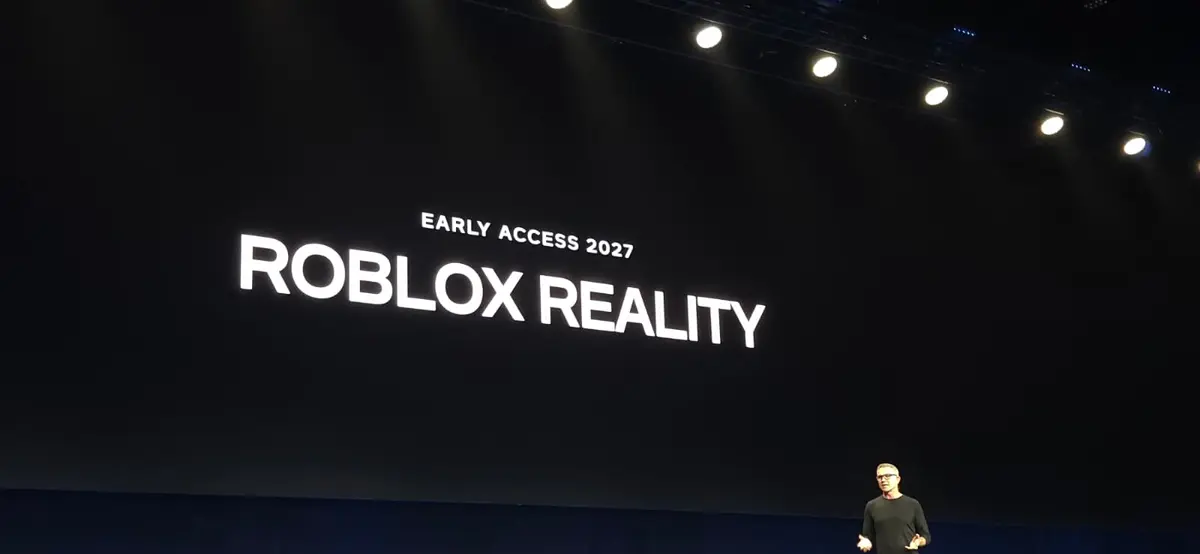
The block closes with the official announcement on screen: "ROBLOX REALITY," dated for Early Access in 2027.
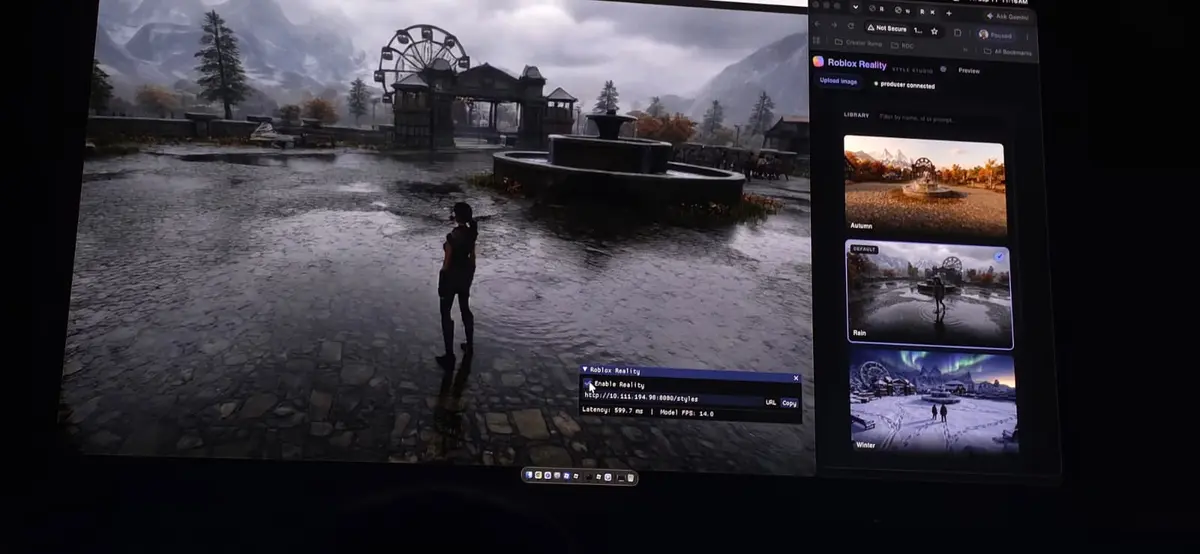
With the Rain style active, the same plaza from before appears flooded, under an overcast sky and desaturated color — the entire scene reinterpreted in real time, without touching a single asset of the original scene.
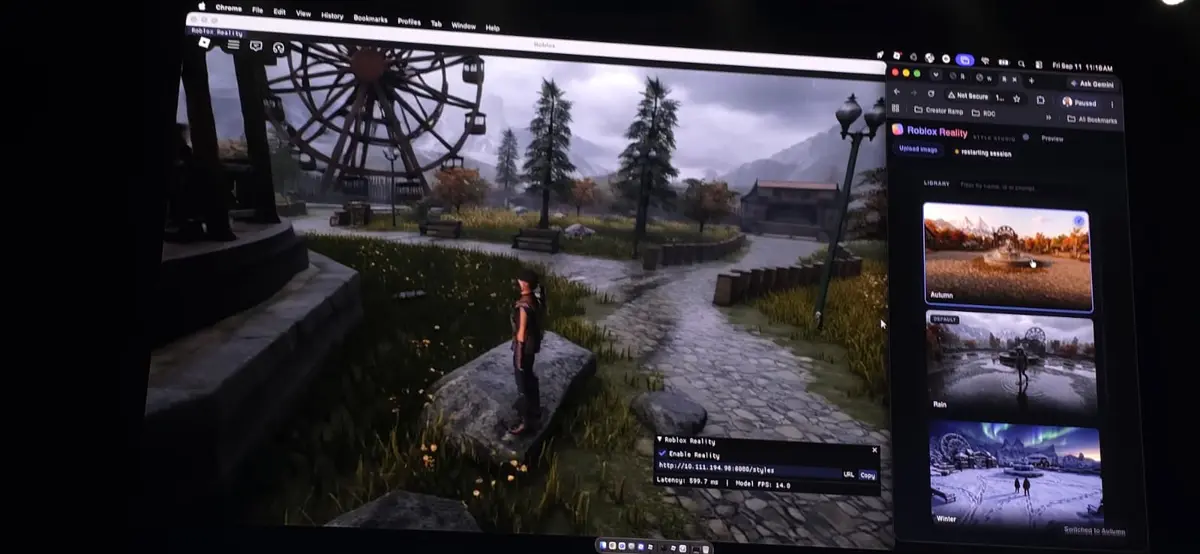
Selecting Autumn in the panel restarts the session and changes the scene from the ground up: clear skies, autumn leaves, and a different area of the park, with a "Switched to Autumn" label confirming the change.
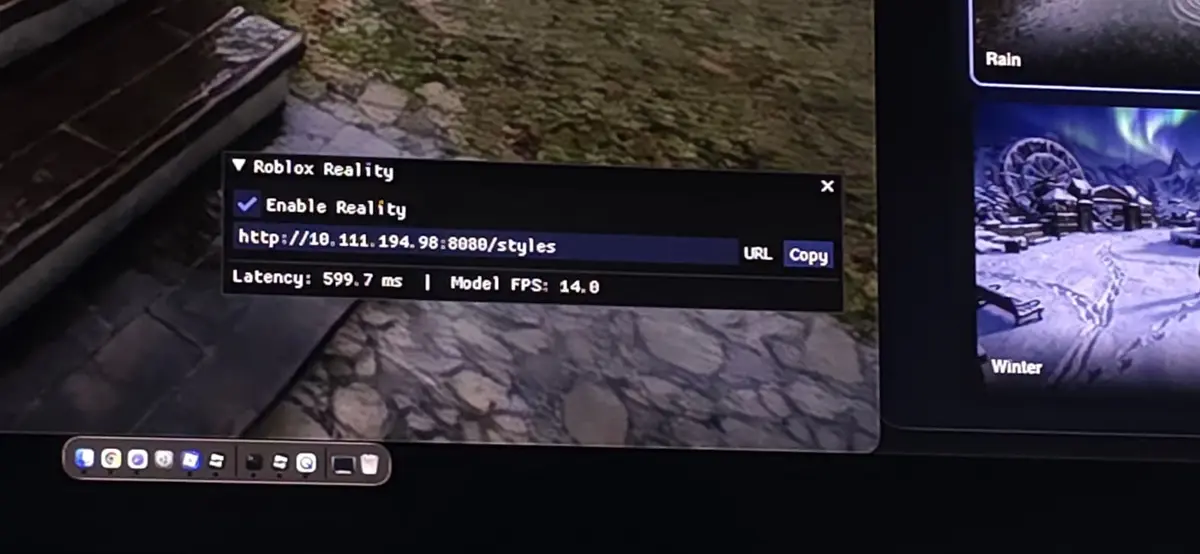
The control panel shows the technical data behind this real-time transformation: 599.7 ms latency and 14.0 model FPS, alongside the full library of available styles (Autumn, Rain, Winter).
And finally, Winter: the same scene, now snowy and at night, with the northern lights over the mountains.

Álvaro Monzón offers a technical read on this demo: what was shown —completely changing a 3D scene's theming in real time with a single click— recalls the technology behind DLSS5 and approaches like Decart's, both centered on neural rendering and real-time video generation applied to interactive worlds.
A new demo inside the same theme park: a side panel called "Roblox Reality" (Style Studio) lets you pick from several preset visual styles —Autumn, Rain (default), and Winter with the northern lights— and apply them live to the scene being explored, with a producer connected remotely controlling the change.

With the style applied, the avatar walks through the same entrance plaza and Ferris wheel seen earlier, now at a latency of 599.7 ms and 14.0 FPS model rate, per the debug overlay shown on screen.

This block closes with the moment we'd been waiting for: joining the two speakers who've carried the whole AI demo on stage, Roblox CEO David Baszucki steps up.

The scene seen so far in Studio was also shown inside the actual Roblox client, with an avatar walking through the entrance plaza, the fountain, and the Ferris wheel in the background — confirming that the AI-generated output is already a real playable experience, not just an editor preview.

The block closed with a screen summarizing the four areas of AI applied to creation in Roblox shown in this part of the keynote: Coding, 3D, NPC, and Video.

The demo went one step further: on the same already-built park, the AI assistant applied new text instructions one after another in real time —confetti, ground flowers, an interior fence— generating and running the corresponding code for each change without leaving Roblox Studio.

Álvaro Monzón's first reaction to this part of the demo: the most striking part isn't just building a scene from scratch, but being able to change the entire theming of an already-built environment with a single prompt. The feature is still in development —"work in progress," as Roblox's own team clarified on stage— but with a launch promised soon, and potential that, if it holds up, could change the way environments are created inside Roblox.
The demo revealed how that scene was built: a single text prompt describing a simple, "chunky" theme park — with a go-kart track, hedge maze, Ferris wheel, entrance plaza with a fountain, carousel, and food shops, simple geometry and solid colors — turned directly into a complete 3D scene. Roblox's AI assistant built and published it in 13 minutes and 53 seconds.

On that same foundation, the demo also showed procedural generation of individual assets inside the Studio assistant: the command "/generate_procedural_model a fence" created and inserted a wooden fence directly into the scene.

The finished result, seen inside Roblox Studio: ornamental arches, the Ferris wheel, and the rest of the park's props generated from that same prompt, with snow-capped mountains in the background.


The level of detail extends to the carousel props, with fully modeled and textured horses.

Anupam Singh, SVP of Engineering, and Karun Channa, Sr Director of Product at Roblox, take the stage for the keynote's next block, focused on AI tools applied to creation within Roblox.


As a preview of what's coming, a phone showed "Theme Park Kartway," a playable go-kart experience set inside a theme park, with its own track and a Ferris wheel in the background.


The game used in the demo is called "Fruit Fight," with four teams — Yellow, Green, Red, and Blue — throwing fruit at each other. Roblox showed on screen the "Log Analysis Report," automatically generated from data captured by the headless clients, with hitrate, damage per hit, eliminations per hit, and eliminations per throw for each team.

The finding confirmed what was already suspected: Team Yellow was unbalanced — a single hit was enough to eliminate an opponent. The fix proposed by the analysis itself: drop Yellow team's damage to 2 points.

Roblox announced "Playtest Agent," an AI agent for testing games, coming soon with multiplayer support.

"Playtest Agent" is built on headless Roblox clients that run in the platform's own cloud to automate game testing. These clients can be scripted via API or driven by the same NPC behavior technology. In the demo shown, 100 AI agents faced off in a team food fight (4 teams of 25 players each), each making its own decisions with nothing choreographed. The system captured gameplay data from each client's perspective, and the analysis revealed Team Yellow was consistently overpowered. Their proposed workflow: describe the behavior, watch it play out, spot the imbalance, fix it, and retest.
And the demo reached its resolution: following the quest Victoria had given, the player confronted BanditBoss by throwing tomatoes from their inventory, with the AI responding in real time to the action within the game world itself.

Quest resolved, the player went back to Victoria to claim the reward: a golden smoothie.
Dynamic Behavior is just the first in a planned series of NPC improvements Roblox has underway. The next step, they said, is giving NPCs human-level agency — able to play, think, and react the way a real player would. Anyone wanting to dig deeper has a breakout session the following day: "Fast-Paced Discord NPCs."
The demo picked back up live inside Roblox Studio with the NPC Victoria seen earlier: talking to her, she explains that the bandit boss stole her entire harvest and asks for help getting it back by throwing tomatoes at her.


Approaching the NPC BanditBoss afterward and asking about the theft, she gives the opposite version: she claims she stole nothing and accuses Victoria herself of taking the town from her. Each character keeps its own consistent, dynamic perspective on the story, generated by AI in real time.

The player, Xiao, interacted freely with both characters with no dialogue menu involved — all built entirely inside Roblox Studio, with no cutscenes and no pre-scripted dialogue trees.
Oren Jacob, Sr Director of Engineering, and Xiao Yu, Principal Machine Learning Engineer at Roblox, have taken the stage for the keynote's next block.


Their first announcement was "NPC Dynamic Behavior," with a Studio beta arriving by the end of 2026.

The mechanic behind it: each NPC is defined by a simple text prompt describing who they are and what they want, with no pre-authored dialogue trees — the system resolves behavior in the moment. That prompt is editable, versionable, and reusable across multiple NPCs: changing it automatically updates every downstream conversation and behavior.
Roblox showed an early-stage sneak peek of its upcoming terrain tools: a Terrain Style tool with non-destructive voxel editing to shape roads, paths, and streams on the fly, with the world responding intelligently (terrain rises, foliage adjusts automatically); Terrain Decals projected directly onto the voxel terrain, backed by a new virtual texturing system able to scale to very large terrains, with the ability to rotate and follow curvature and elevation; a scattering system for rule-based procedural foliage placement, painting layers to build rich, detailed environments; and signed distance fields combined with virtual texturing so distant terrain keeps sharp ridgelines and defined materials, with no popping.


From our seats, Álvaro Monzón couldn't help but react live: "it's incredible!"
Oren Jacob and Xiao Yu are up next to explain how these worlds will be populated and brought to life.
After explaining the technical optimization, the screen moved on to show the visual leap: first, a mountainous terrain in Roblox's classic, low-detail style.

Then, two shots of a much more detailed and realistic snowy forest, with trees, rocks, and lighting far beyond the classic terrain, showing the new level of fidelity terrain and environment creation tools can now reach.


Elkoura reviewed this year's big platform wins: texture streaming shipped with zero creator action required, and those results — -11% out-of-memory crashes and +1.9% playtime platform-wide (equivalent to over 6 million additional hours of engagement per day) — are exactly that aggregate impact, with even stronger gains on Android and lower-powered devices. A later measurement, with more features rolled out, pushed those figures to -13% crashes and +2.7% playtime (data from experiments run between August 13 and 30, 2026). On-demand cloud transcoders, mesh/texture streaming, and SLIM compositing have all shipped, benefiting all existing content automatically.


The explanation arrived under the title "TERRAIN": the improvement consists of sending serialized terrain data to the cloud instead of storing it in the place file itself, resulting in -98% file size, -90% CPU memory, and -45% meshing latency.
Roblox is fully committed to making the platform's terrain "the best in the world." Terrain Early Access launched in June 2026, with hierarchical LOD improvements and terrain data removed from place files — faster loads, less CPU overhead, and less storage — and the terrain area has expanded from 4×4 km to 16×16 km, more than double the area of San Francisco.


George Elkoura, Roblox's Sr Director of Engineering, has taken over on stage for the keynote's next segment.


The game generated with "Build" already came with developer products ready to sell for Robux: a "Speed 5x" boost for 100 Robux and a "Health" power-up for 20 Robux, both marked as on sale.

Roblox also confirmed that "Build" access is expanding to all RDC26 attendees, not just a small test group.

Beyond creating the game, "Build" includes full management from mobile: ads (create and manage ad campaigns without going through the Creator Hub), stats (DAU, playtime, and retention at your fingertips, with an analytics agent that lets you ask about any metric conversationally), and economy (edit developer products — prices, items — live from the app, instantly).
Every attendee in the room got access today. It's currently live in three countries, with broader expansion implied to follow; the team expects richer, more intelligent features in future updates and explicitly asked for creator feedback.
First demo: inside Roblox Studio, an AI-powered NPC behavior generation panel lets you define a character's personality and script through a text prompt — in this case, "Victoria," an NPC with instructions on how to react to the player depending on the story context.

Next came a mobile analytics panel, showing metrics like daily active users, total playtime, D1 retention, payer conversion, and ARPPU, all accessible directly from the phone.


The most striking demo was "Build," the mobile-first creation tool: from the app, a simple text prompt — "Build me a theme park with a moving Ferris wheel and a go cart track" — is enough for the AI to start generating the full experience. Roblox explained that "Build" is an AI-powered game creation and management platform, launched in alpha this summer and so far available in Singapore, Serbia, and New Zealand — as of 9am today it's rolling out to all creators. Already over 100,000 users have tried creating a game, with early examples ranging from math tutors and 2D puzzles to obbies and horror games.
Creation works by prompt: you describe the game and an agent builds it, drawing on multiple models running in parallel — a coding model, 3D foundation models, image generation, and an audio catalog. Existing Studio games also show up inside Build, with full playtest support.

Nishchaie Khanna, Roblox's Sr Director of Engineering, has taken over on stage for the keynote's next segment.


The screen brought back Roblox's original logo, with the historic tagline "You Make the Game," as part of the lead-up to the platform's 20th anniversary in 2027.

Alongside the earlier AI coding diagram, a new one was added, "Build / Studio Build": a model router distributing work across code generation, image, and mesh/XR, passing through a "Judge," applying domain tools, running an NPC-agent playtest, and finishing with human review.

A map of four layers — Consumer AI Layer, Professional AI Layer, Human Create Layer, and OS Layer/Runtime Layer — was also shown, placing general-software examples next to their Roblox equivalent: against tools like Replit, Lovable, or Cursor/Claude Code/Codex in the software world, Roblox lines up 2D games/3D reality, Build, Studio Build, and Roblox Studio, all backed by the engine, RCC, infrastructure, persistence, events, client, economy, safety, and social graph.

As a parallel, he pointed out that software development already moved from autocomplete to generating full apps through agentic loops; gaming is harder, because it needs models for code, audio, 3D objects, entire systems, and NPCs. Roblox is positioning itself as an AI operating system plus an AI creation layer for gaming. Within that framework, "Build" is the new, mobile-first creation tool that will sit alongside Studio — which will in turn gain the same capabilities. The end vision: everyone building games the way they once shared videos.
The timeline continued into video game evolution: 3D multiplayer (1987), 3D multiplayer with user-generated content (1996), high-resolution 3D (2007), and, as the next horizon, photorealistic multiplayer, still without a date shown on screen.

To illustrate that horizon, a demo with photorealistic graphics was shown.

A diagram of an AI-assisted coding workflow was also shown ("Coding Harness Example"): a general-purpose model, generic tools, a verification loop, the repo or pull request, and finally code review (human or agent). Baszucki framed all of this within what he called "the creation revolution": the shift from analog to digital creation, now giving way to AI-accelerated creation, with the stated goal of the world's best content being built on Roblox. He described it as two forces converging: Roblox OS (engine, cloud, services) as the foundation, and an AI creation layer on top accelerating speed and quality.
On gaming's unfinished spec, he drew a parallel with TV and video: there, hardware has already caught up with the original vision (4K, 120Hz, cheap). Gaming is different — the full spec has never actually been implemented, from Pong to UGC 3D multiplayer, but photorealistic multiplayer still doesn't exist. The target spec: real-time, any device, anywhere, with NPCs and full photorealism. He summed it up in one phrase: "the holodeck."
To get there, he described what he calls the Roblox Reality architecture: a cloud game engine handling synchronized, persistent world state, physics, logic, and object positions, with a video world model layered on top for lighting and fine detail — something he said traditional 3D engines will struggle to handle alone. His stated belief is that this will be the first photorealistic multiplayer gaming architecture to exist.

David Baszucki is back on stage, picking up the "Build" pillar from the three strategic pillars presented at the start of his address.

He walked through a timeline of the audiovisual industry's evolution: black and white movies (1888), movies with sound (mid-1920s), TV (mid-1930s), and QuickTime (1991). We don't yet have the full thread of where this comparison is heading; we'll add it here as soon as we do.

The screen confirmed in writing what had just been announced moments earlier: "Incubator Class of 2027," with applications opening in winter 2026.

A new screen then organized the engine's capabilities into three blocks: "World," "Characters," and "Game." We don't yet have the detail of what was said under each; we'll expand on this as soon as we do.

Ateş presented Roblox Incubator, a six-month intensive sprint program with hands-on support, access to Roblox experts, and marketing resources. The current cohort brings together about 24 creator teams spanning design, engineering, and discoverability, mixing seasoned Roblox developers with others coming from other platforms, in what she described as a cross-pollinating community where creators push each other forward. Running in parallel is Jumpstart, a rolling-entry program for developers launching their first novel game on Roblox.


The four games from the 2026 cohort were shown, all shipping today on a shared engine foundation: Starforged (Making Fun), Aetherfall (Pixel Blaze Studio), Fossil Force (Nibble Byte), and Scrapbook Saga (Beta, V Bucks, and Zechro).

The shared challenge across all four titles, she explained, is adding more detail, scale, and expression while keeping performance on low-end devices. The engine's streaming systems handle world-level detail automatically — texture streaming and occlusion culling running in the background, loading the right mesh and texture representations as players move through the environment. Character systems have also expanded: Flim now supports R15 platform avatars, with continued expansion, plus new avatar rigs and movement systems giving creators more control over character response. As a highlight, Scrapbook Saga is a 2.5D world using the Input Action System for cross-platform input and mesh/texture streaming for scalability. The stated goal: have the engine continuously manage geometry, texture, detail, and rendering per device, so creators can focus on world and gameplay.

Finally, she announced that applications for the 2027 Incubator cohort will open in winter 2026, with more details in the weeks ahead, encouraging developers to apply with "your most ambitious pitches."
Ceren Ateş, Roblox's Director of Creator Ecosystem, has taken over on stage for the keynote's next segment.


The segment continued under the title "Playing with Friends," backed by an internal Roblox survey of about 54,000 users conducted between April 11 and 16, 2025.

Seb Barrios, also Roblox's SVP of Engineering, then joined on stage to build out this segment focused on playing with friends, one of the pillars Roblox places at the core of its future.


A demo showed Voice Calling, continuous voice chat between trusted friends coming next year, designed to keep the conversation going even as players move from one game to another, with a call window overlaid on gameplay.

The demo continued live inside Dragon Adventures to showcase Voice Typing: the speakers' own voices were transcribed in real time by Roblox's AI, with corresponding safety guardrails, and a continuous mode lets messages send without any manual input.


The segment closed with a batch of additional announcements: a Friends tab inside the chat window itself (launching this week) to chat with and invite friends without leaving the game or switching apps; emojis coming soon to chat; and Quick Words (formerly "Super Safe Chat"), a catalog of curated, age-appropriate words for in-game coordination, which developers can now extend by submitting custom words specific to their game for Roblox to review before they go live.
As a closing thought, the team stressed that playing with friends is the number one reason people come to Roblox, and that investment in chat is framed as a platform-level priority, not just another feature.
Raj Sripathi's segment focuses on chat under the title "Making chat livelier." As context, he noted that Roblox handles 1.4 billion chat messages a day across the platform, and that guardrails on who can chat with whom were added earlier in 2026 to protect younger users — a move he acknowledged as a source of friction for developers, but one he considers necessary.


He structured the segment around three pillars: "The Social Default" — friends chatting, planning, and joining games without leaving Roblox — "Intelligent Coordination" — safe coordination across all ages to keep gameplay going — and "Multimodal Future" — text and voice working together seamlessly.

The 30 million daily messages figure shown earlier actually refers to Global Chat, the cross-server chat feature within the same game that launched recently and passed that mark within months of launch. A real-time moderation system ("green phrasing") keeps conversations civil.
Raj Sripathi, Roblox's Sr Director of Engineering, has taken over on stage for the keynote's next segment.


Direct Launch: one-tap game access. Nick Tornow presented game-specific shortcuts that launch directly from the Android home screen, eliminating multiple taps through the Roblox app. It's rolling out on Android shortly after this RDC, with iOS and Windows to follow.

2D and 2.5D engine enhancements. A new orthographic camera mode has been added, rendering objects at the same size regardless of their distance from the camera and enabling a crisp 2.5D look. It's joined by animated image containers and direct spritesheet import support, enabling parallax and 3D background objects, plus new UI system capabilities: blur shadows (including text and inner shadows) and 2D particles. A Studio beta is coming soon, with full shipping before year's end. Tornow stressed this isn't a separate 2D engine — it's built into the existing engine, benefiting all Roblox games.


Offline play. Roblox is enabling a new class of games that run without a network connection, syncing progress once connectivity is restored. Games can launch fully offline, with no pre-launch required, and online and offline modes can be mixed within a single experience — some game modes working online, others offline, within the same title.
Summing up, Tornow closed the segment with three pillars — Direct Launch, 2D/2.5D engine enhancements, and offline play — designed to complement each other and enable new play patterns. The next segment will be led by Raj Sripathi, focused on chat and social features.

Nick Tornow, Roblox's SVP of Engineering, has taken over on stage to walk through the keynote's first major announcement in detail.


Baszucki structured his vision around three strategic pillars: Play (opening new ways to connect, communicate, and experience games), Build (new tools and technology, with an AI-powered creation layer), and Growth (discoverability and creator monetization).
He also argued that digital play is catching up to physical play — watching, chatting, arguing, and creating are already happening together — and flagged growth focus on the 18+ demographic, a large and fast-growing segment he considers still underserved on Roblox, especially around 2D casual games (puzzle, fast/casual). The goal, he said, is to make it easier to build and experience a wider variety of play styles. As a long-term vision, he spoke of an evolution from today's multiplayer 3D immersive worlds toward what he called "Roblox Reality."
Baszucki kept backing his address with data, showing a breakdown of US gaming industry revenue by age and format (2D/3D, single/multiplayer). Building on that, he introduced the day's first major announcement under the theme "Welcome more play to Roblox," displaying the app's navigation bar with its icons: Home, Moments, Build, Chat, and Me.


David Baszucki's address continues under the theme "The world needs more play," backed by a figure that struck the audience: 29 billion hours of play logged in the quarter ended June 30, 2026, across more than 180 countries. Baszucki acknowledged that investment in safety systems has created short-term friction on the platform, which he considers worth it for long-term value, and went further, describing games as cultural artifacts on par with books, records, and TV.


Baszucki opened his address with a reflection on play as humanity's oldest connection technology, predating civilization itself, tracing an arc from the campfire to the stadium to the internet, with play always at the center. Framing today's world as more fragmented than ever, he positioned play as one of the few things that still connects people, presenting Roblox's mission as a cultural contribution, not just a business.


The main screen announced David Baszucki's arrival, Roblox's co-founder and CEO, to applause from a packed auditorium eager for his address.


The opening keynote has just kicked off, presented by Jay, from Roblox's Developer Relations team and head of creator relations. The opening message was clear: the Roblox Developers Conference exists to hear directly from creators, whose feedback — both the positive and the more "spicy" kind — shapes the platform, described as "the backbone of everything we do."
Roblox promised major announcements covering the platform's past, present, and future throughout the event, plus dedicated Q&A forums running all weekend, including a live Q&A with CEO David Baszucki (Dave) taking open questions.

A video look at the venue right before the main keynote kicks off.
The team is now seated inside the main auditorium, with the screens and lighting rig set up as the keynote is about to begin any moment.

The first attendees are now arriving at the venue, with the official RDC26 banners hanging along the hallways and the welcome catering already set up ahead of the keynote.

The DeuSens team is now accredited and inside the RDC26 venue, in great company alongside the other guests. Here's how the arrival looked:


Today is when the major announcements of the Roblox Developers Conference 2026 (RDC26) concentrate. The main keynote starts at 10:00 AM California time, 7:00 PM in Europe (a nine-hour difference). From there, we kept adding every update as it came in from the event.
The Roblox Developers Conference 2026 (RDC26) is Roblox Corporation's flagship invite-only event for developers, brands, and creators on the platform, held from September 10 to 12, 2026, in San Jose, California.
From September 10 to 12, 2026, in San Jose, California, as confirmed by Roblox in its official announcement.
Yes, Roblox streams the keynotes openly on its official YouTube channel. You can follow it on this article's embedded player or on the official RDC page.
DeuSens, together with its partner BrandNewVerse, attended as one of only two Spanish studios invited, repeating their participation from RDC 2025.
The keynote covered AI applied to creation (dynamic NPC behavior, prompt-based scene generation, "Roblox Reality"), new terrain and engine tools, browser and standalone-app playability, and a strong push on growth (Moments, Robux Wallet, Roblox Plus, Roblox Card). You can revisit the full minute-by-minute detail in the block above.
SIMILAR CONTENT

PRIVACY POLICY
By chatting you accept our Privacy Policy.
By chatting you accept our Privacy Policy.
Conversation sent. We will be in touch shortly. New conversation


