

 RETURN
18.01.2021
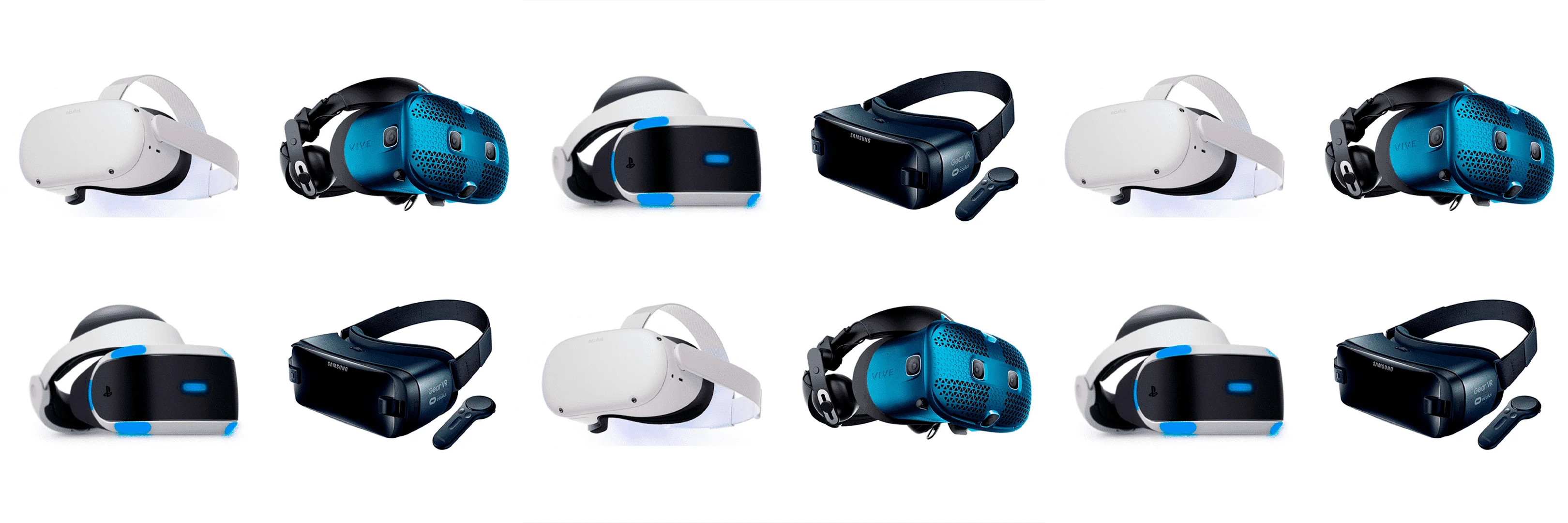
TYPES OF VR DEVICES | What are the types of Virtual Reality glasses that exist?

HIPEREXPERIENCIA
LOADED


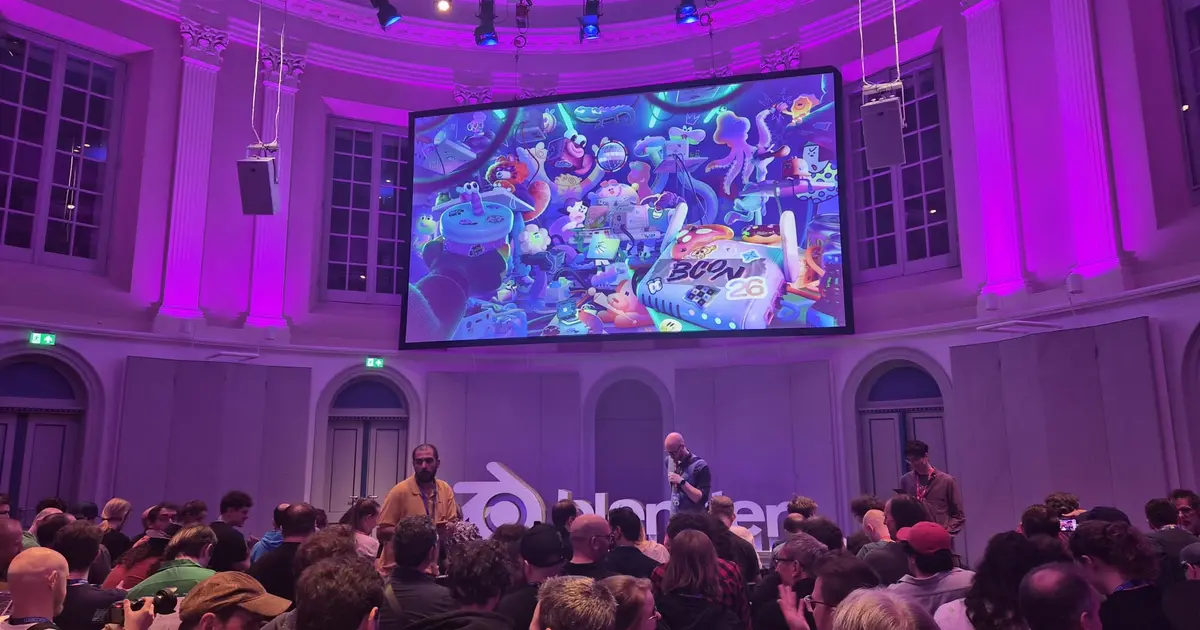
Blender Conference 2026 kicked off on 23 September at Felix Meritis in Amsterdam with Francesco Siddi's first keynote as Blender CEO and a Wacom presentation that tied together Japanese craftsmanship, Blender on Android tablets and verifiable authorship for 3D meshes. The DeuSens team was there in person. This recap covers all three days of the conference.
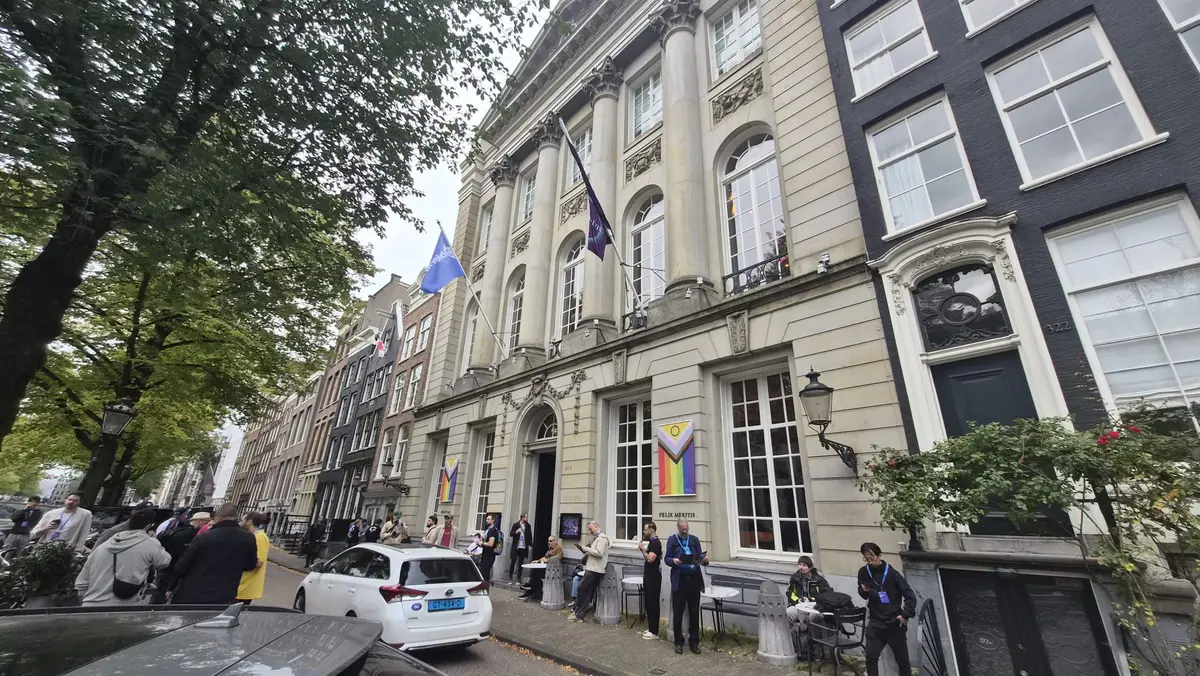
BCON26 took place from 23 to 25 September 2026 at Felix Meritis (Keizersgracht 324), a historic building on the Amsterdam canals with room for around 700 people. The edition sold out. The official programme ran across four parallel rooms —Theater, Studio, Classroom and Attic— plus SIG sessions for special interest groups and language communities. Every talk was recorded and is being published online.
The programme covered a wide spectrum: animation production pipelines, geometry nodes, scientific visualisation, rendering, 3D printing, automotive and XR workflows. It is the gathering where the Blender Foundation sets the software's technical direction for the year ahead.
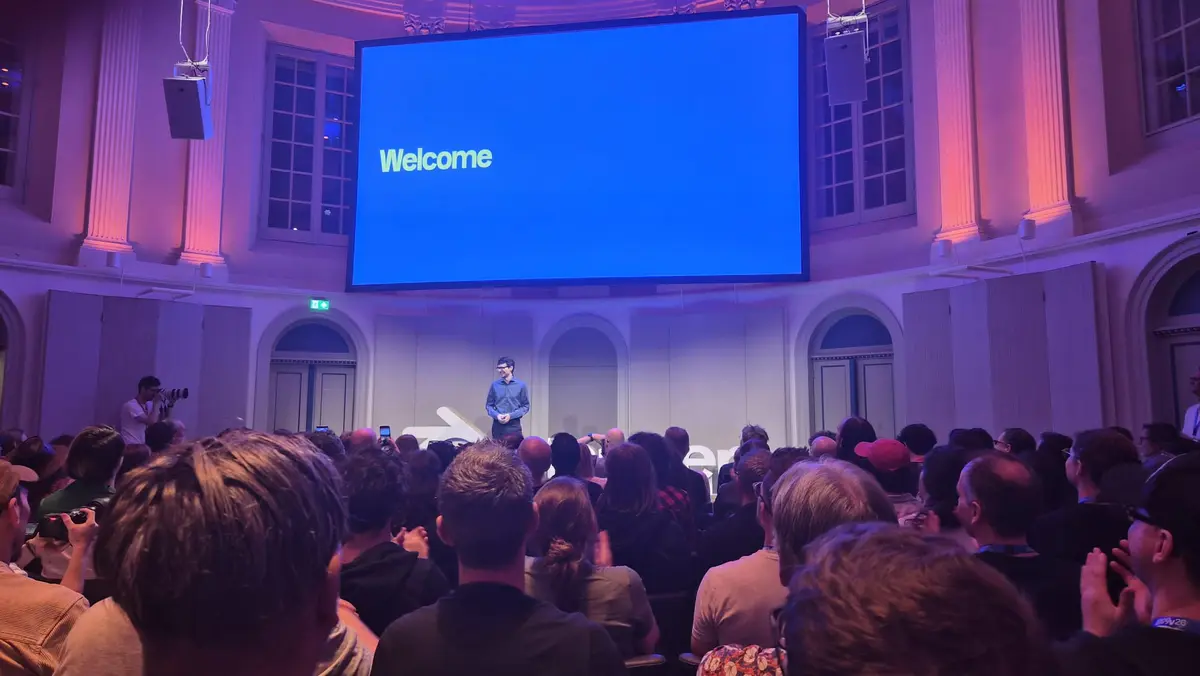
The 11:00 keynote in the Theater was Francesco Siddi's first as Blender CEO, following Ton Roosendaal stepping down from the role on 1 January 2026. Siddi opened with a light-hearted comparison between the two of them and then moved on to the structure of the organisation: the Stichting Blender Foundation as parent entity, with Blender Institute BV and Blender Studio BV beneath it.
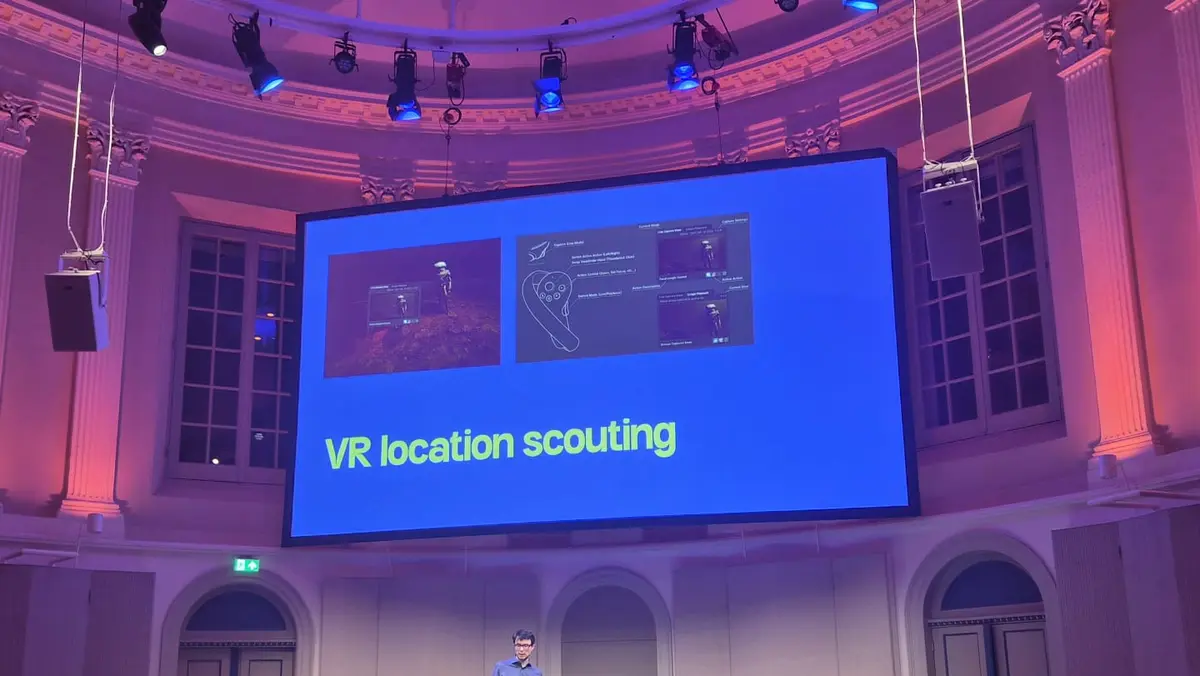
One of the metrics shown was issue tracker resolution time: the project responds to bug reports in under a day and resolves more than half of all issues in under a week. There was also room for VR location scouting, which lets users walk through a Blender scene with a headset and controllers to decide framing and camera positions at real scale. The session closed with a look back at the Blender Studio open movies, from Elephants Dream to Sprite Fright and Charge.
The Foundation stressed transparency: an open roadmap, an annual report, a yearly user survey and an ongoing documentary series. The new strategic goal is for small teams to take on ambitious projects, with the feature film as a case study, in the year the Blender Open Movies turn 20. The keynote also reviewed Blender's growing role in gaming, film and industrial design, and the backing of Netflix Animation Studios as a Corporate Patron of the Development Fund since January.
Alongside the Android port supported by Wacom, shown as a tablet prototype, Siddi highlighted support for Windows on ARM, driven by Qualcomm among others, and upcoming support for NVIDIA hardware such as DGX Spark.
The most impactful technical news was native Gaussian Splatting: Blender 5.3, expected on 10 November, will import splats and render them directly in EEVEE and Cycles, something that until now required external add-ons. Also shown were node-based modelling tools, layered texturing improvements and a complete HDR workflow, from lighting to final export, with HDR support in the Video Sequencer developed during the production of the short Singularity. Among the incremental improvements, the Voxel Remesher now preserves attributes, a Bevel node arrives in Geometry Nodes and Grease Pencil gains one-click fill.
The Blender Lab, the Foundation's space for experimenting with features before integrating them into the core, took centre stage with projects such as VR Location Scouting, planned for Blender 5.2 LTS. The relaunch of Blender Network was also announced.
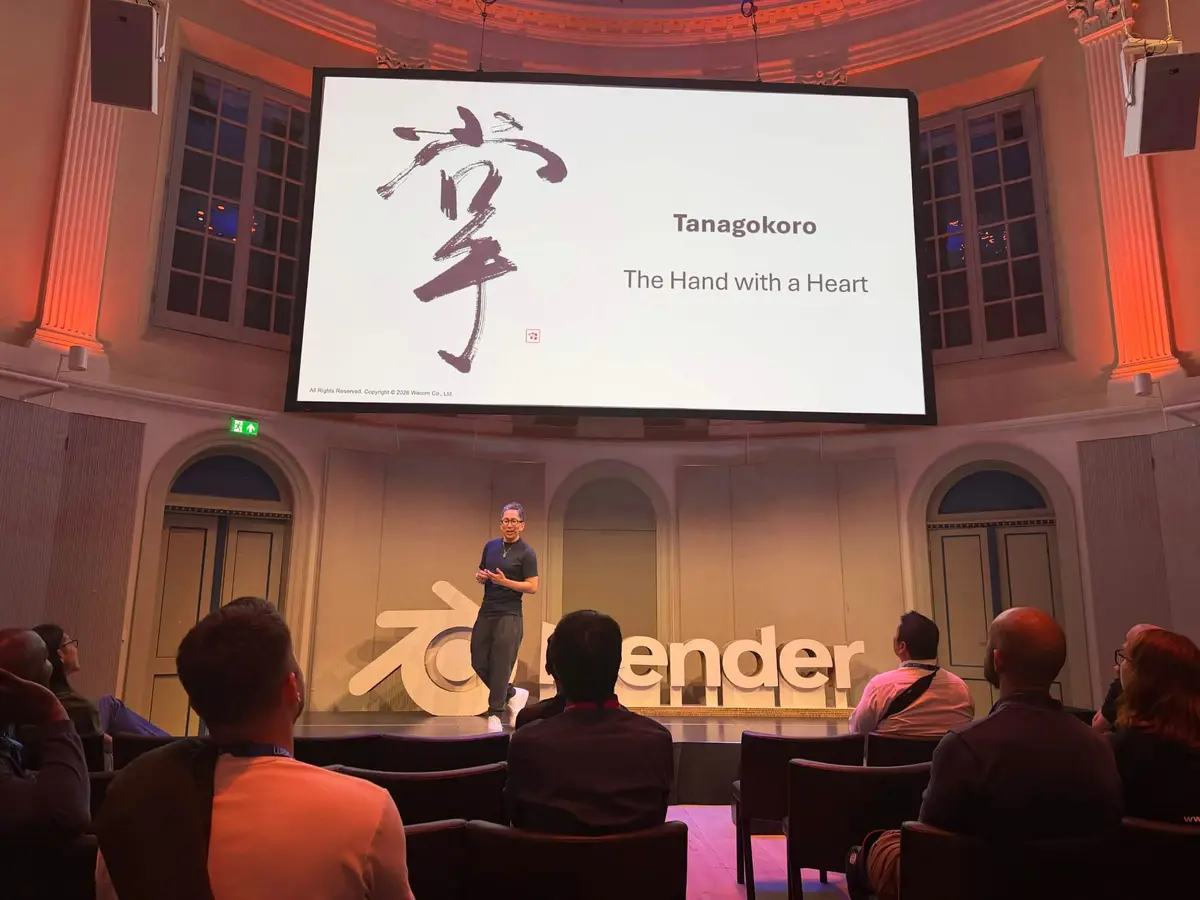
Nobu Ide, President & CEO of Wacom, presented the brand's vision through the Japanese concept of “Dougu-ya”: the craftsman who makes tools in the belief that an instrument is only as good as the hand it serves. Ide linked that idea to “Tanagokoro”, the hand with a heart, and to the physiology of touch: Meissner corpuscles, Merkel cells, Ruffini endings and Pacinian corpuscles, which pick up everything from a light touch to vibration and fine pressure. The thesis: drawing is a two-way conversation between hand and brain, and a digital pen should never interrupt it.
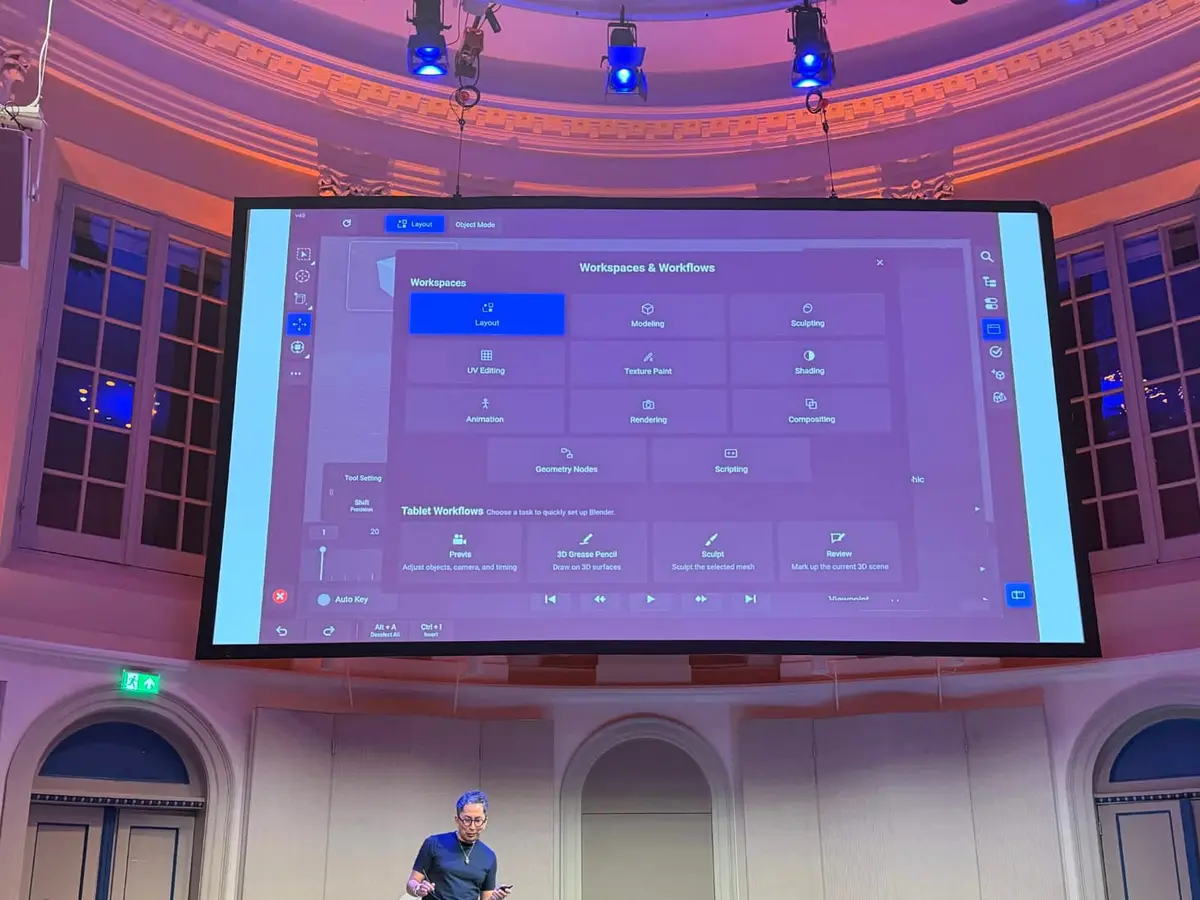
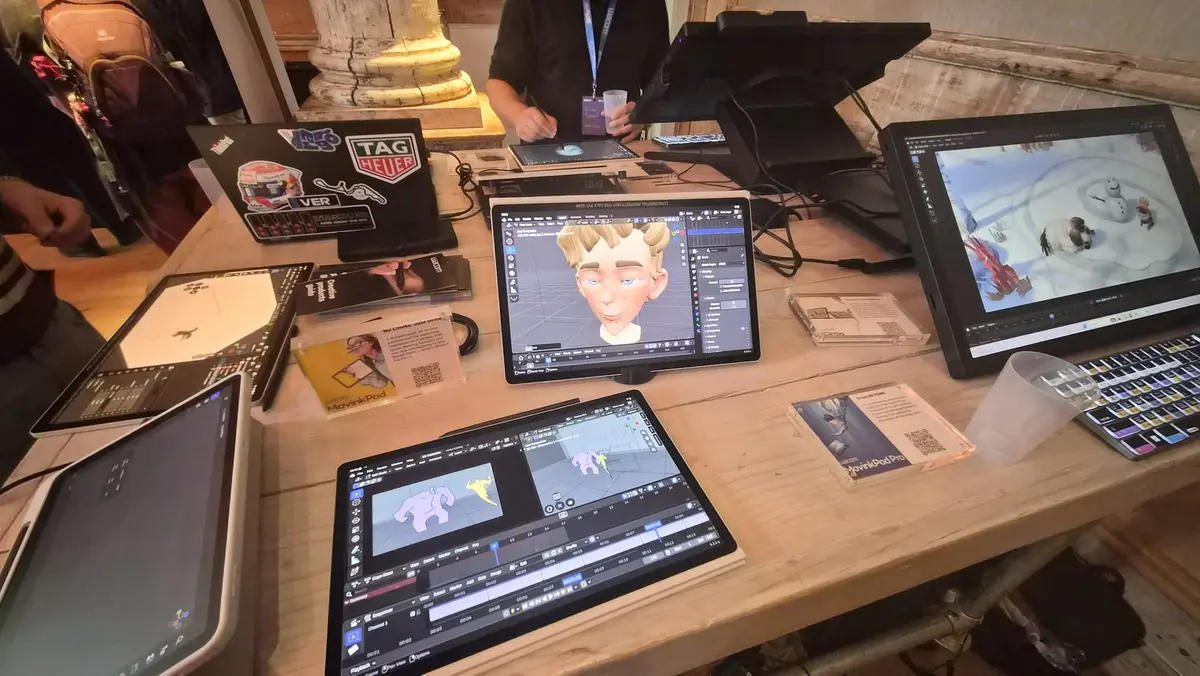
Wacom showed a Blender UX/UI proposal for Android tablets optimised for pen and touch. The start panel grouped the classic workspaces (Layout, Modeling, Sculpting, Animation) alongside “Tablet Workflows”, preset flows for previs, 3D drawing with Grease Pencil, sculpting and scene review. In sculpt mode, the Shift and Ctrl modifiers, the pie menu and undo became on-screen buttons, freeing the canvas from the keyboard.
Wacom has been funding this work since August 2025 as a Corporate Patron of the Blender Development Fund. The proposal is open to community feedback, and on Friday 25 the talk “Porting Blender to Android” by Blender developer Jonas Holzman went into the technical details of the port.
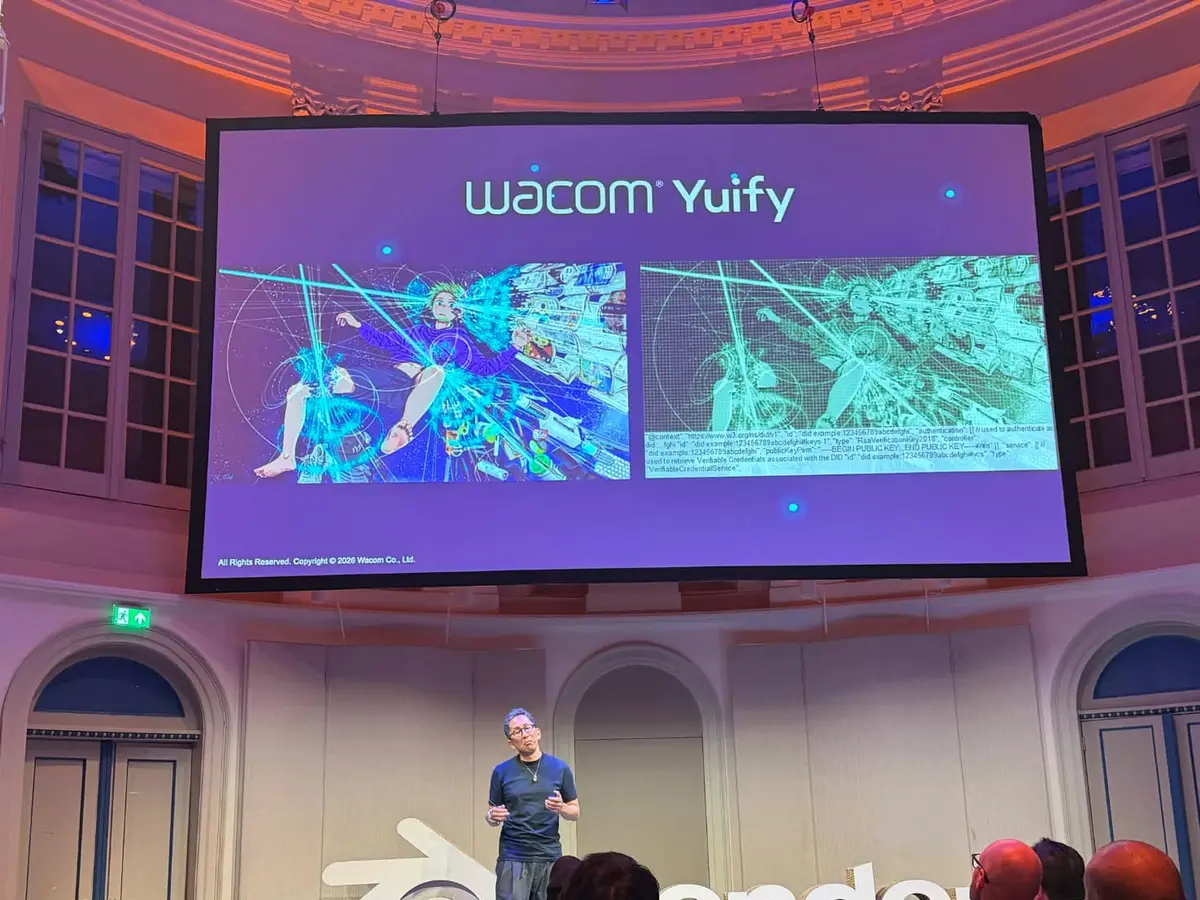
Wacom Yuify, Wacom's service that embeds an invisible micromark in a piece of work to link it to its author, made the jump from 2D to 3D. The demo, featuring the Yui Bunny character, showed how a mesh exported from Blender can carry a verifiable authorship record. Until now, Yuify worked with images from tools such as Clip Studio Paint, Photoshop and ibisPaint.
At a time when 3D assets move between studios, clients and platforms, and generative AI blurs the origin of content, being able to prove who created a mesh becomes a matter of licensing and trust.
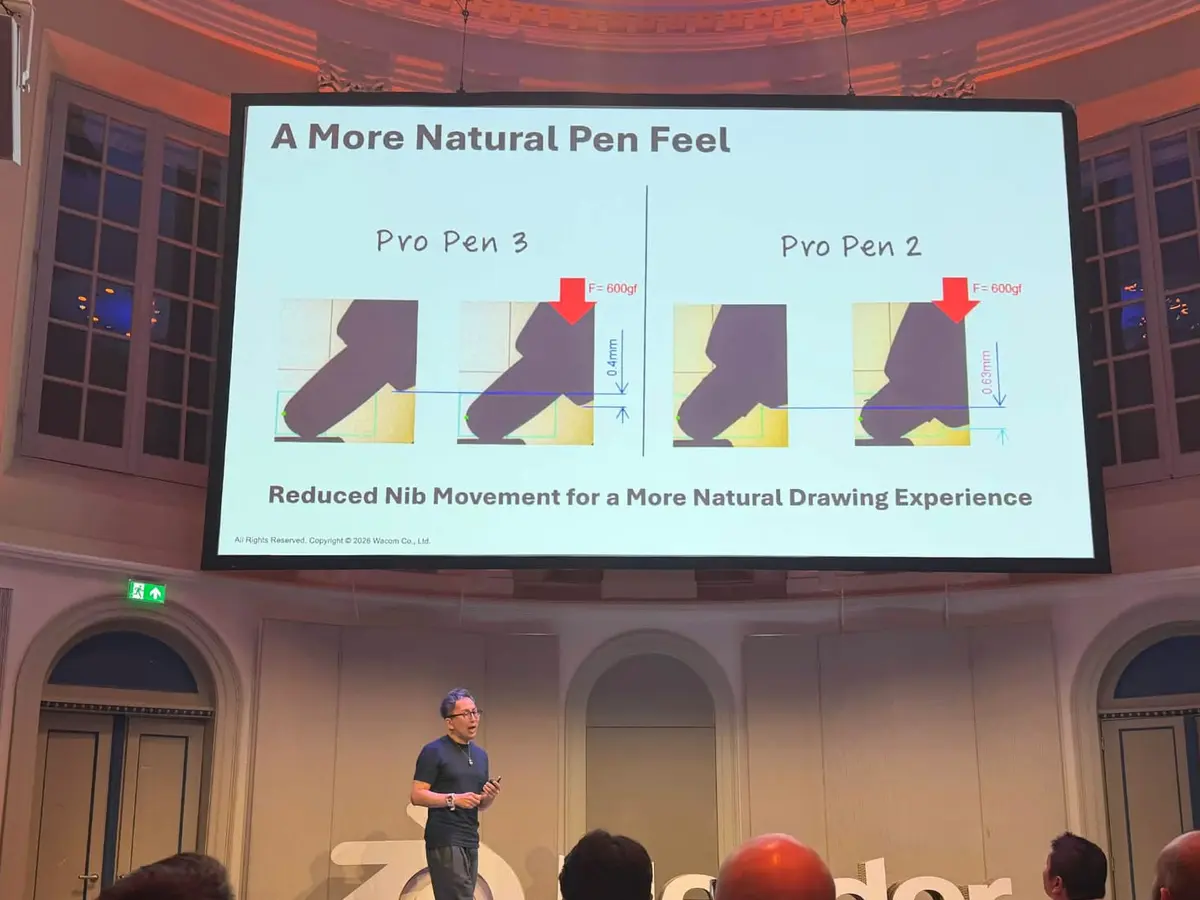
The new Intuos Pro, the first refresh of the range since 2017, was presented as Wacom's flagship for 3D creators. According to the figures shown, the Pro Pen 3 nib sinks 0.4 mm under a 600 g load, compared with 0.63 mm on the Pro Pen 2: strokes respond sooner and the feel is more direct. At around 4 mm thick at its thinnest point, Wacom said the wrist angle drops from 20° to 10°, easing posture during long sessions. The brand also highlighted consistent pressure and linearity across pens, the result of algorithms, firmware and factory calibration.
Wacom closed with its “Life-long Ink” vision and its support for the community: events such as Tokyo Anim Unite in Tokyo and Connected Ink, and tools developed together with creators themselves.
If the first day looked at the software's future, the second showed where it already stands. Automotive, video game, television and animated film studios showed how Blender has become the core of their pipelines. The conversation is no longer about whether Blender is up to the task, but about how to build in-house tools that turn repetitive work into creative decisions.
Kim Jern, Rodrigo Candell and Ardalan Farboud explained how an automotive modelling department works with Blender: from the designer's quick sketch to the 3D model, through clay milling and hand finishing, all the way to production surfaces. They showed a show car completed entirely in Blender for an upcoming motor show. They highlighted speed and flexibility, and their wish list includes native NURBS and augmented reality support to review the car at real scale.
Markus Biegholdt and Rob Green of Atomhawk, a visual development studio with more than 15 years of experience in AAA games, explained that their concept artists spend up to 95% of their time in Blender. They work with a shared startup file, shared asset libraries and procedural generators that build a convincing scene in minutes, so what you see in the viewport is practically the final image.
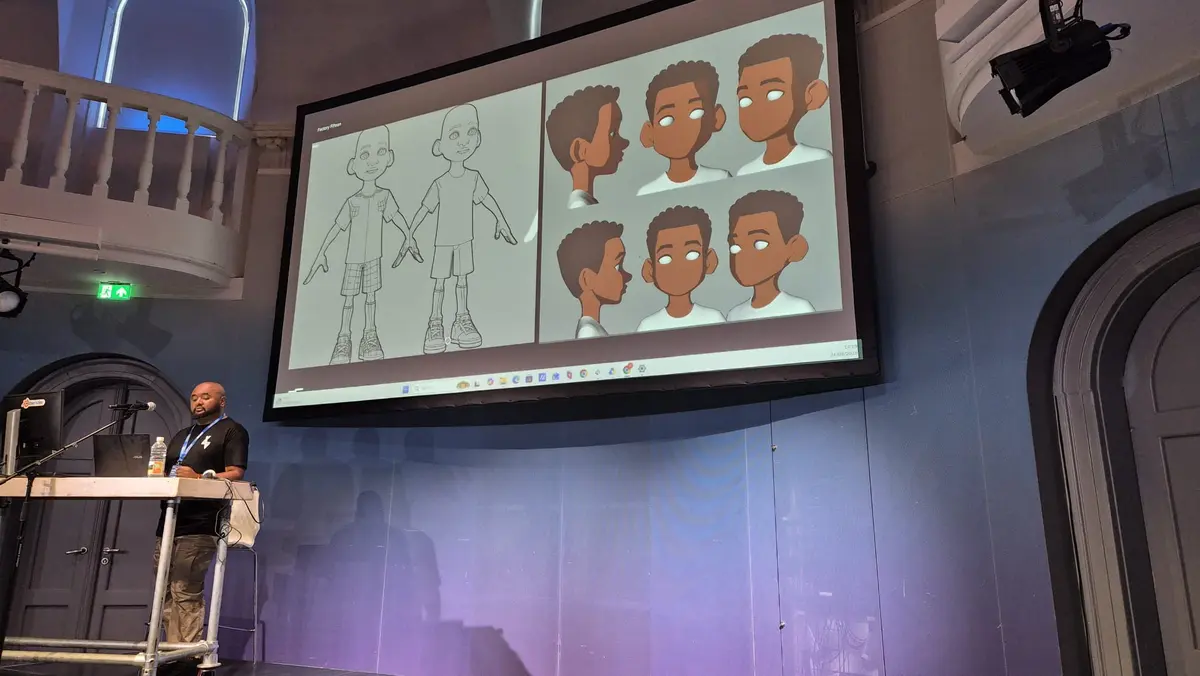
Ricardo David of Factory Fifteen broke down the animated sequences of Crongton, the BBC series based on Alex Wheatle's novels that won the 2026 BAFTA for Children's Scripted. The team chose 3D with a 2D finish, with dynamic cameras and hand-drawn imperfections, and found in Grease Pencil a way to “think 2D in space”. Animation stayed in Maya while Blender handled layout, lighting and rendering. Their conclusion: let creative ambition choose the tools, not the other way round.
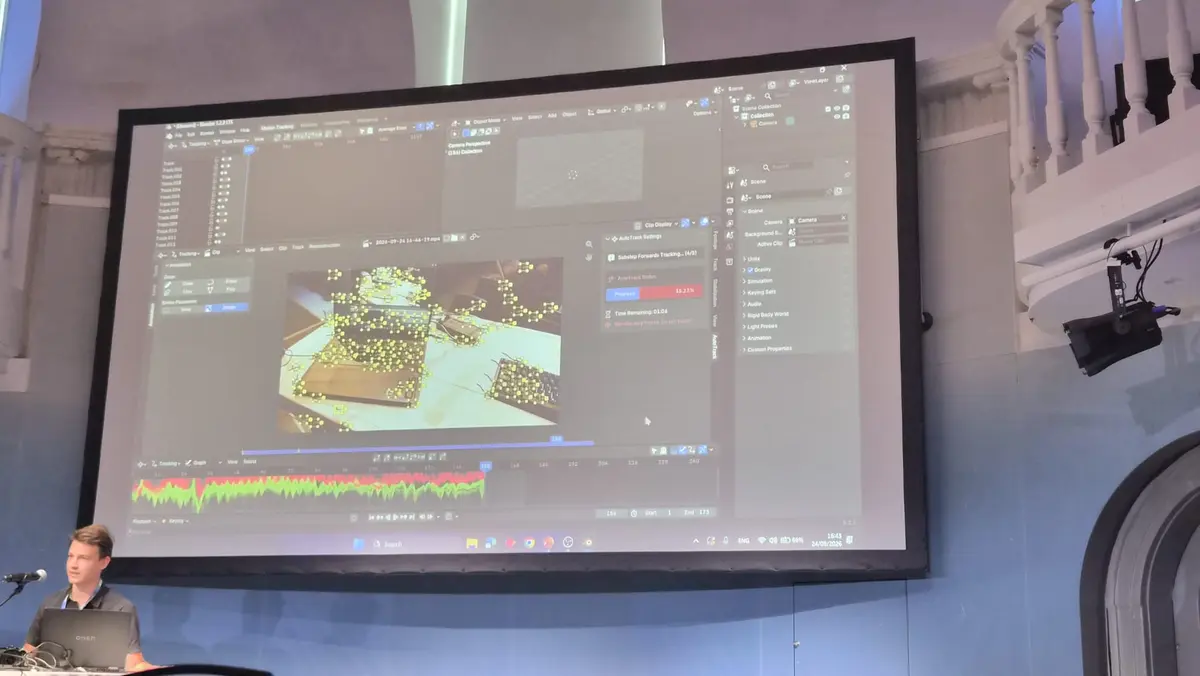
Several talks shared the same idea: stop repeating manual work. Demeter Dzadik of Blender Studio presented CloudRig, his component-based rigging system. Siemen Lens showed AutoTrack, a free and open-source extension that automates camera tracking, one of the most dreaded tasks in VFX, solving a simple shot in about five minutes. Gilad Harnik showed a procedural street and building system with a bold thesis: Geometry Nodes is neither an artistic nor a programming tool, but a decision-making tool.
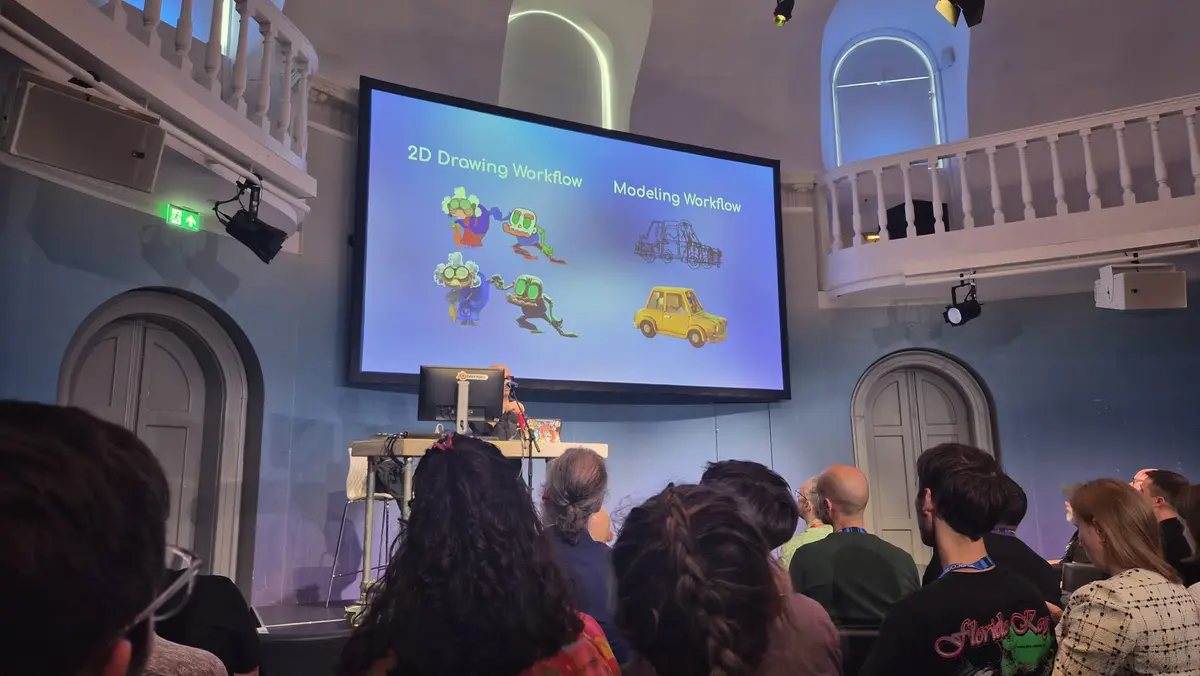
Daniel Martínez Lara, director of Pepe School Land and Goya winner for Alike, presented Clay Pencil, an official Blender Lab project that turns animations drawn in Grease Pencil into 3D geometry, bringing the spontaneity of hand drawing into the 3D animation workflow.
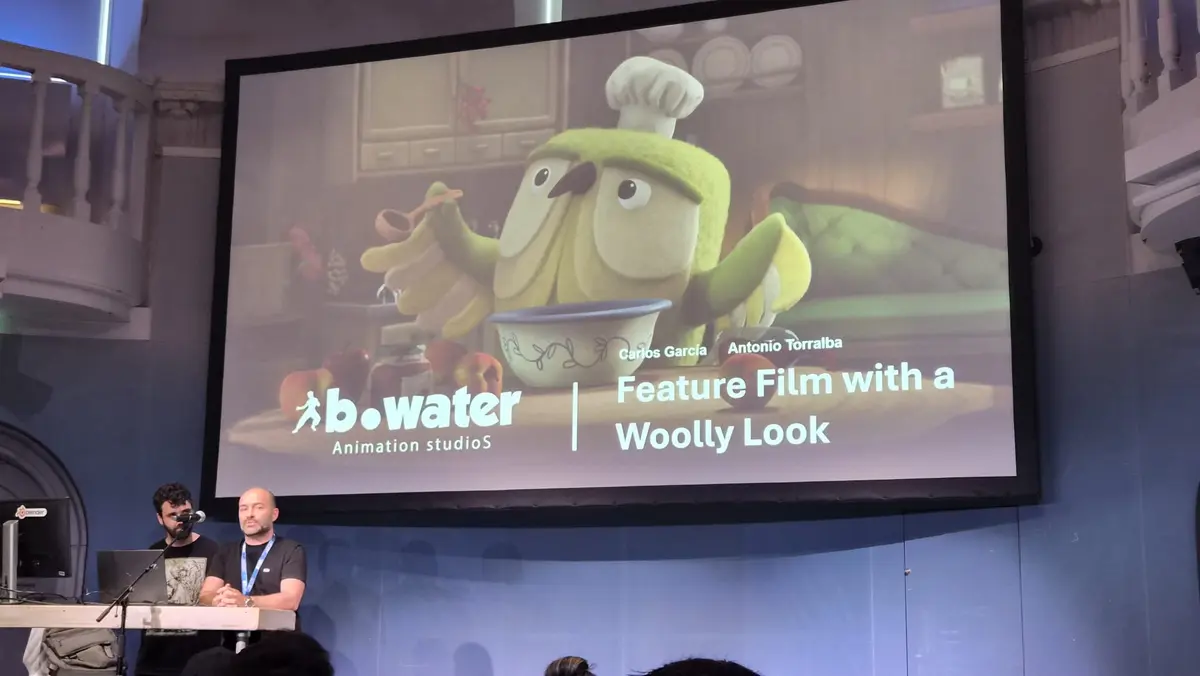
Spanish studio b-water studios, based in Barcelona and Tenerife, closed the day with the complete pipeline of its feature film Pikkuli and Starlight Reindeer: 3D characters with the look of felt and wool toys over 2D backgrounds, produced entirely in Blender on a tight budget. To convince a US client used to other tools, they compared renders and the differences were minimal: in their words, the prejudice against Blender is “ten years out of date”. The fur, without simulation, resolves around 99% of contacts using procedural techniques.
The closing day combined immersive technology, science and celebration: PICO's work to bring XR into the heart of Blender, a first look at Blender Studio's feature film and a closing dedicated to the community.
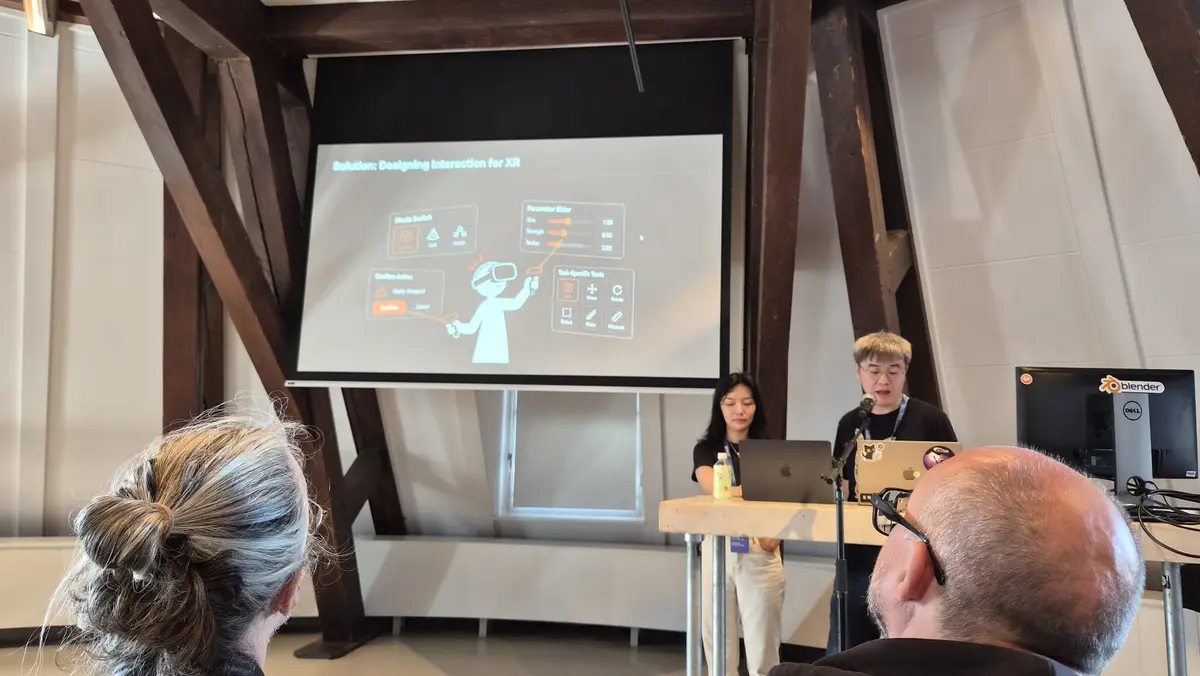
Ruoya Sheng and Junfeng She of PICO reviewed the past year of progress in Blender XR. PICO has been collaborating with the Blender Foundation on OpenXR development since July 2025 and was the first XR platform to do so. They presented a PCVR workflow that turns the headset into a complete spatial workstation: artists can switch to the virtual desktop and control their peripherals without taking the headset off. The talk centred on two challenges: avoiding the constant switch of context and input system between VR and desktop, and removing the need to take off the headset. The result is an uninterrupted iteration loop in which modelling and reviewing at real scale stop being separate tasks.
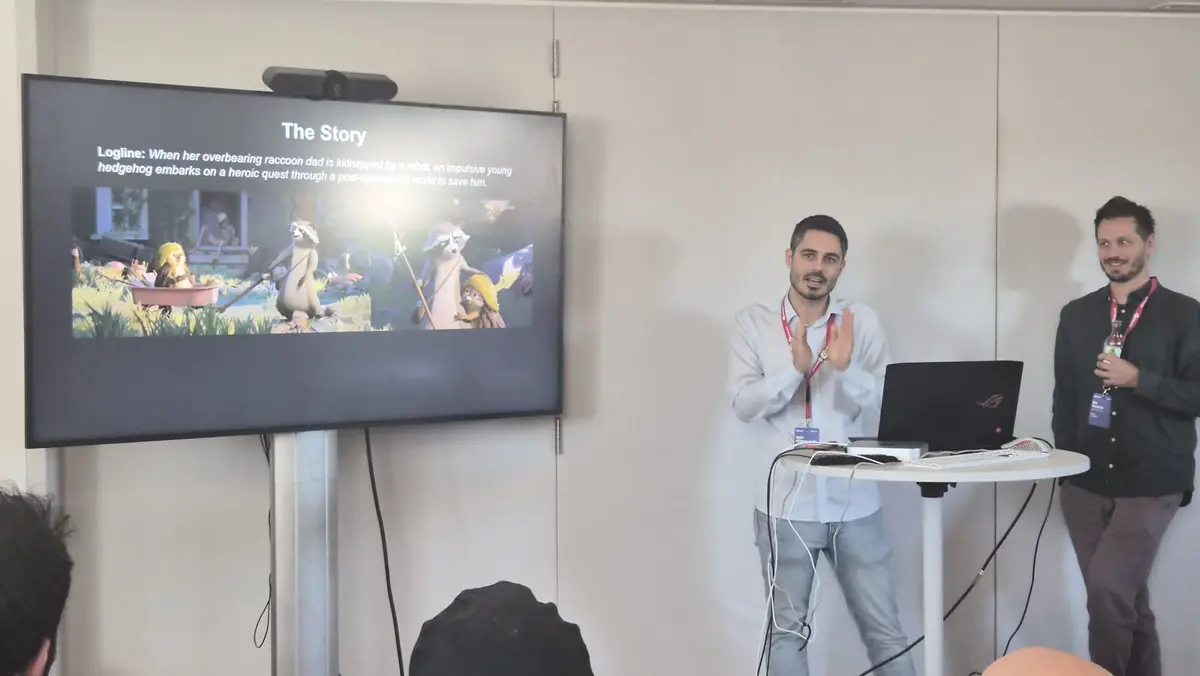
Francesco Siddi, co-directors Hjalti Hjálmarsson and Rik Schutte and Anastasia Rudina gave a sneak peek of OVERGROWN, Blender Studio's feature film. The story: when her overbearing raccoon dad is kidnapped by a robot, an impulsive young hedgehog, his adopted daughter, embarks on a heroic quest to rescue him through a post-apocalyptic world reclaimed by nature. The message: no matter your size or strength, anyone can be the hero they want to see in the world.
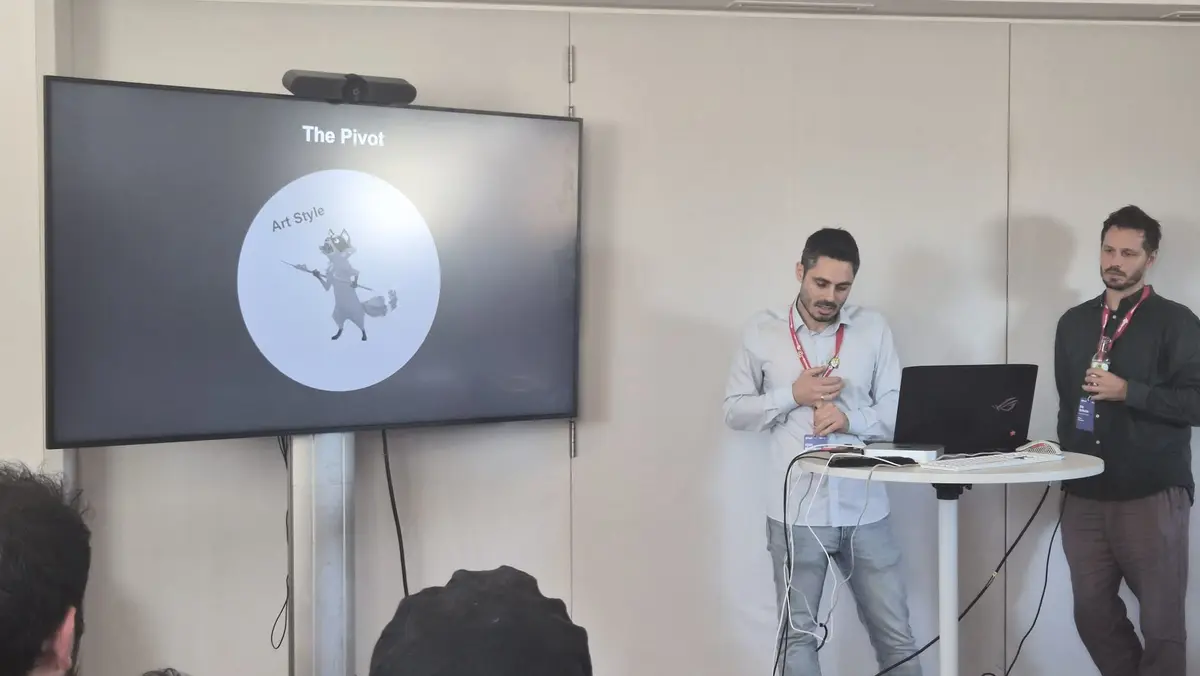
The session was a very honest making-of of the teaser. The team first explored an illustrated-book style, with watercolour and backgrounds that fade away, and then flat shading with a limited palette as a creative constraint. But at 75-80% of the way through came the big pivot: with no dialogue, all the emotional weight rested on the design, and feedback had pushed the characters towards a generic style that drained their personality. The team stopped, rethought the art direction based on proposals by Andy Goralczyk and Vivien Lulkowski, added dialogue and restructured the script while keeping the characters, emotional arcs and message. Characters had to be redesigned and re-rigged, Geometry Nodes effects adapted and almost all the animation redone. The lesson they shared: a late pivot has a real cost in lost work, and facing it takes a team able to stay motivated.
OVERGROWN is also more than a film. Blender Studio wants to build a “feature playbook”: open-source tools and documentation so that small teams can take on feature-length productions, without depending on cloud services or generative AI. It is the embodiment of the “Small teams, ambitious projects” motto that opened the conference. The project is funded through Blender Studio subscriptions.
Alisa Ovsiannikova presented SciExplorer, a prototype that turns Blender into a tool for interactive exploration of scientific data: it connects 3D structures obtained through microscopy with their measurement tables so they can be filtered, compared and plotted without leaving the program. She demonstrated it with the trunk of an early-stage human embryo and with mouse heart mitochondria, where the tool helped spot suspiciously large structures that could be segmentation errors. One more example of Blender as a visualisation platform far beyond entertainment.
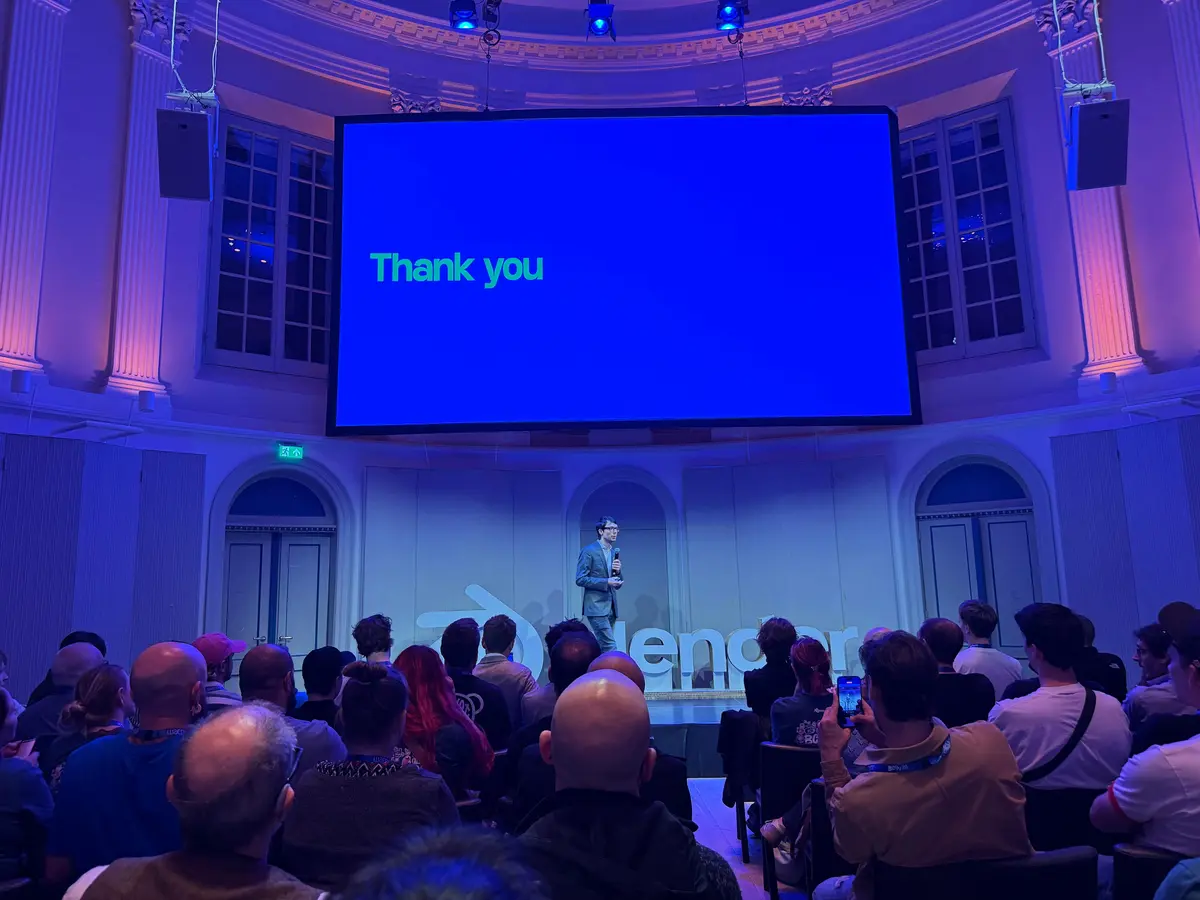
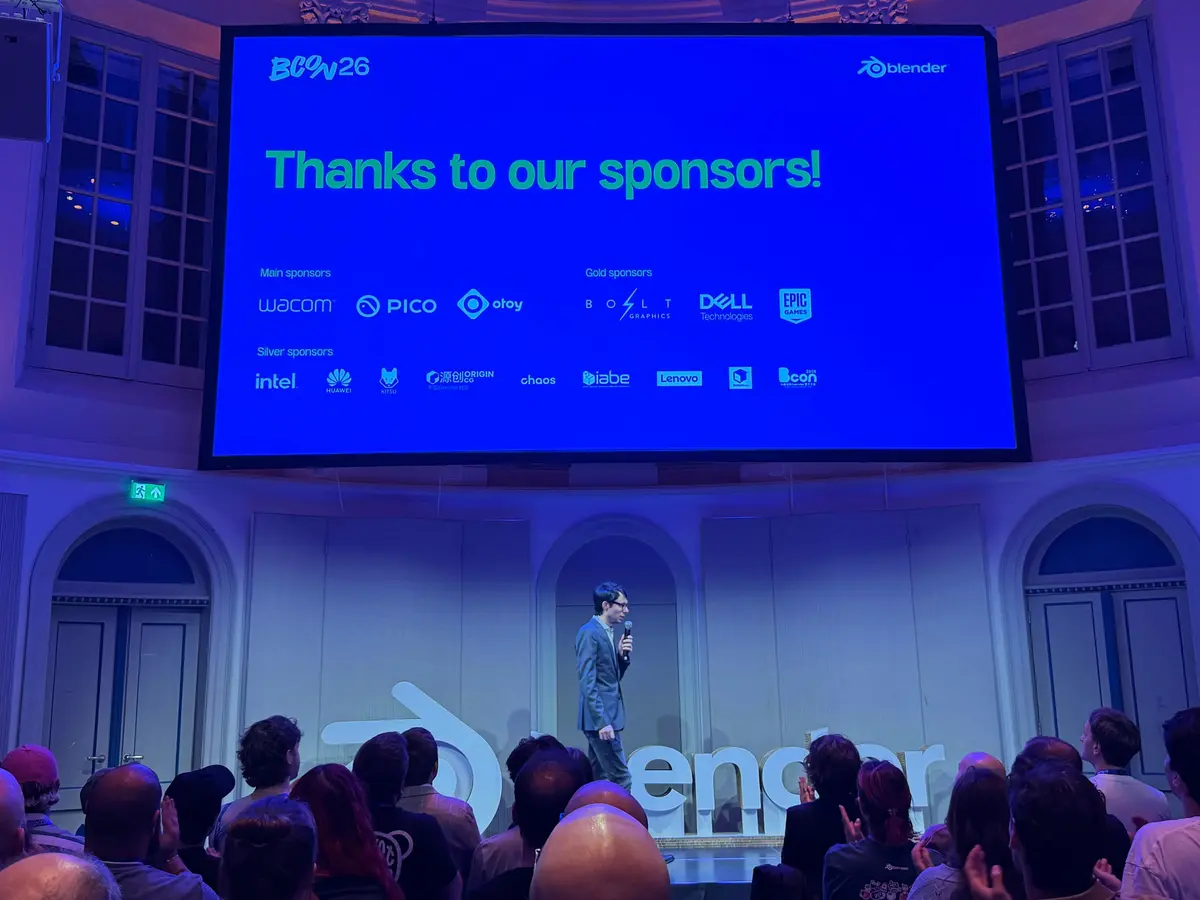
The closing event had a warm, human tone with no technical announcements: thanks to the community that makes the conference possible and a celebration of 20 years of Blender open movies, from Elephants Dream in 2006 to DOGWALK, 18 open projects that have driven the software's development. To celebrate, the team printed one frame for every second of its open movies, around 3,000, mounted them by hand on panels and let attendees take some home. A reminder that behind every frame there are hours of animation, lighting and review, and that open work is meant to be shared. The closing ended with an invitation to give your first talk, even if it goes wrong, because in the long run it pays off. The edition's main sponsors included Wacom, PICO and OTOY.
For a studio like DeuSens, the three days sent six clear signals. First: Blender on a tablet opens the door to reviewing scenes and adjusting assets on site, while setting up an interactive installation or in a client meeting, without depending on a workstation. Second: verifiable mesh authorship matters in projects where the 3D models of a virtual reality experience or a digital twin are licensed or reused. Third: VR location scouting reinforces something we apply in immersive production, which is validating space and scale inside the headset before building. Fourth, and perhaps most relevant: native Gaussian Splatting will bring photoreal captures of real spaces into Blender and render them directly, a leap forward for digital twins and XR environments. Fifth: the automotive industry asking for augmented reality to review designs at real scale confirms something we see every day, the demand for immersive product review. And sixth: PICO's work to remove the need to take off the headset points to pipelines where creating and reviewing in virtual reality are part of the same flow, exactly the kind of production we apply in our immersive experiences.
BCON26 left a clear picture of where Blender stands: a renewed organisation, software opening up to new platforms and formats, from Gaussian Splatting to XR, and an industry that already uses it at the core of production in automotive, games, television and film. The conference talks are being published on the official Blender YouTube channel.
From 23 to 25 September 2026 at Felix Meritis in Amsterdam (the Netherlands).
Francesco Siddi, Blender CEO since January 2026, in his first keynote in the role.
Blender is working on an official Android port with Wacom's support. At BCON26, an interface proposal for pen and touch was shown, still open to feedback.
The 3D extension of Wacom's authorship service: it lets a Blender mesh carry a verifiable record of who created it.
Its release is expected on 10 November 2026 and it will include native Gaussian Splatting.
The Blender Foundation's experimentation space for prototyping features before integrating them into Blender.
Blender Studio's first feature film, co-directed by Hjalti Hjálmarsson and Rik Schutte, developed with Blender and open-source tools that will be shared with the community.
SIMILAR CONTENT

PRIVACY POLICY
By chatting you accept our Privacy Policy.
By chatting you accept our Privacy Policy.
Conversation sent. We will be in touch shortly. New conversation


